

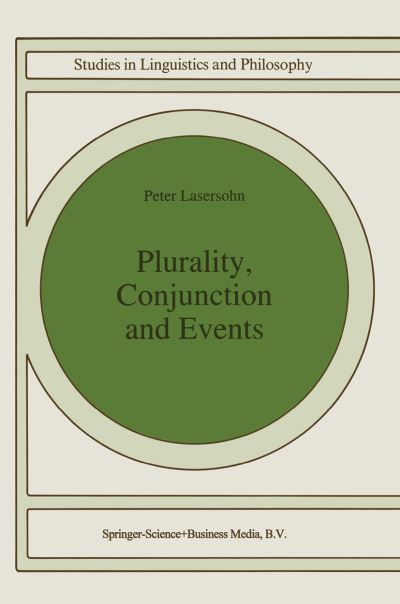
Plurality, Conjunction and Events presents a novel theory of plural and conjoined phrases, in an event-based semantic framework. It begins by reviewing options for treating the alternation between `collective' and `distributive' readings of sentences containing plural or conjoined noun phrases, including analyses from both the modern and the premodern literature.
It is argued that plural and conjoined noun phrases are unambiguously group-denoting, and that the collective/distributive distinction therefore must be located in the predicates with which these noun phrases combine. More specifically, predicates must have a hidden argument place for events; the collective/distributive distinction may then be represented in the part/whole structure of these events.
This allows a natural treatment of `collectivizing' adverbial expressions, and of `pluractional' affixes; it also allows a unified semantics for conjunction, in which conjoined sentences and predicates denote groups of events, much like conjoined noun phrases denote groups of individuals.
| ISBN: | 9780792332381 |
| Publication date: | 31st December 1994 |
| Author: | Peter Lasersohn |
| Publisher: | Springer an imprint of Springer Netherlands |
| Format: | Hardback |
| Pagination: | 304 pages |
| Series: | Studies in Linguistics and Philosophy |
| Genres: |
Semiotics / semiology Philosophy: logic Philosophy of language Linguistics |
Plurality, Conjunction and Events presents a novel theory of plural and conjoined phrases, in an event-based semantic framework. It begins by reviewing options for treating the alternation between `collective' and `distributive' readings of sentences containing plural or conjoined noun phrases, including analyses from both the modern and the premodern literature.
Plurality, Conjunction, and Events features in the following genres: Semiotics / semiology, Philosophy: logic, Philosophy of language, Linguistics
Hardback. Not Available.
Plurality, Conjunction, and Events was written by Peter Lasersohn and published by Springer an imprint of Springer Netherlands
Plurality, Conjunction, and Events has 304 pages
Yes it is part of Studies in Linguistics and Philosophy series