

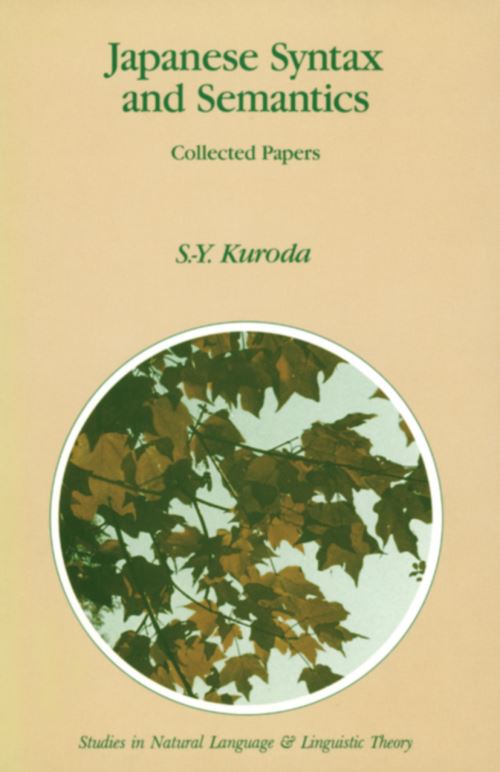
1. Two main themes connect the papers on Japanese syntax collected in this volume: movements of noun phrases and case marking, although each in turn relates to other issues in syntax and semantics. These two themes can be traced back to my 1965 MIT dissertation.
The problem of the so-called topic marker wa is a perennial problem in Japanese linguistics. I devoted Chapter 2 of my dissertation to the problem of wa. My primary concern there was transformational genera- tive syntax.
I was interested in the light that Chomsky'S new theory could shed on the understanding of Japanese sentence structure. I generalized the problem of deriving wa-phrases to the problem of deriving phrases accompanied by the quantifier-like particles mo, demo, sae as well as wa. These particles, mo, demo and sae may roughly be equated with a/so, or something like it and even, respectively, and are grouped together with wa under the name of huku-zyosi as a subcategory of particles in Kokugogaku, Japanese scholarship on Japanese grammar.
This taxonomy itself is a straightforward consequence of distributional analysis, and does not require the mechanisms of transformational grammar. My transformational analysis of wa, and by extension, that of the other huku- zyosi, consisted in formally relating the function of the post-nominal use of wa to that of the post-predicative use by means of what I called an attachment transformation.
| ISBN: | 9780792313908 |
| Publication date: | 29th February 1992 |
| Author: | SY Kuroda |
| Publisher: | Springer an imprint of Springer Netherlands |
| Format: | Hardback |
| Pagination: | 373 pages |
| Series: | Studies in Natural Language and Linguistic Theory |
| Genres: |
Grammar, syntax and morphology Semiotics / semiology Language: reference and general |
1. Two main themes connect the papers on Japanese syntax collected in this volume: movements of noun phrases and case marking, although each in turn relates to other issues in syntax and semantics.
Japanese Syntax and Semantics features in the following genres: Grammar, syntax and morphology, Semiotics / semiology, Language: reference and general
Paperback, Hardback. Not Available.
Japanese Syntax and Semantics was written by SY Kuroda and published by Springer an imprint of Springer Netherlands
Japanese Syntax and Semantics has 373 pages
Yes it is part of Studies in Natural Language and Linguistic Theory series