

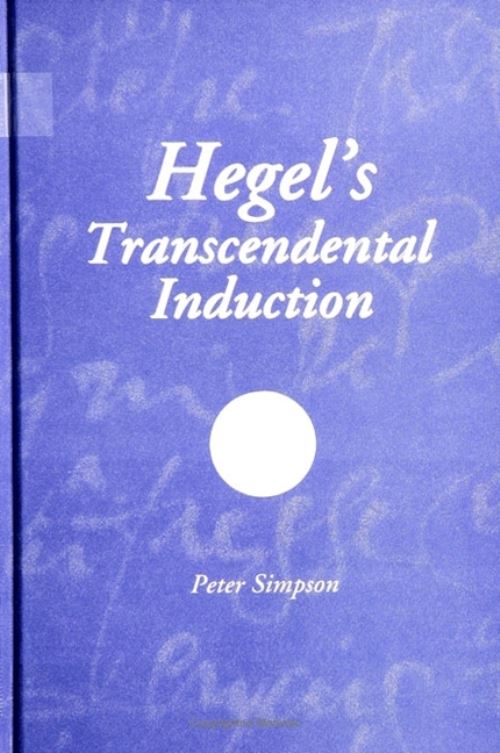
Challenges the orthodox account of Hegelian phenomenology as hyper-rationalism, arguing that Hegel's insistence on the primacy of experience in the development of scientific knowledge amounts to a kind of empiricism, or inductive epistemology.
Hegel's Transcendental Induction challenges the orthodox account of Hegelian phenomenology as a hyper-rationalism, arguing that Hegel's insistence on the primacy of experience in the development of scientific knowledge amounts to a kind of empiricism, or inductive epistemology. While the inductive element does not exclude an emphasis on deductive demonstration as well, Hegel's phenomenological description of knowledge demonstrates why knowing becomes scientific only to the extent that it recognizes its dependence on experience.
Simpson's argument closely parallels Hegel's own in the Phenomenology of Spirit, highlighting those sections, like Hegel's analysis of mastery and slavery, that contribute to the argument that knowing is both vulnerable and responsive to the way in which experience resists our attempts to make sense of things. Simpson's argument connects his account of Hegelian phenomenology with traditional accounts of induction, and with a number of other commentators.
| ISBN: | 9780791432761 |
| Publication date: | 18th December 1997 |
| Author: | Peter Simpson |
| Publisher: | SUNY Press an imprint of State University of New York Press |
| Format: | Paperback |
| Pagination: | 159 pages |
| Series: | SUNY Series in Hegelian Studies |
| Genres: |
Philosophy |
Challenges the orthodox account of Hegelian phenomenology as hyper-rationalism, arguing that Hegel's insistence on the primacy of experience in the development of scientific knowledge amounts to a kind of empiricism, or inductive epistemology.Hegel's Transcendental Induction challenges the orthodox account of Hegelian phenomenology as a hyper-rationalism, arguing that Hegel's insistence on the primacy of experience in the development of scientific knowledge amounts to a kind of empiricism, or inductive epistemology. While the inductive element does not exclude an emphasis on deductive demonstration as well, Hegel's phenomenological description of knowledge demonstrates why knowing becomes scientific only to the extent that it recognizes its dependence on experience.Simpson's argument closely parallels Hegel's own in the Phenomenology of Spirit, highlighting those sections, like Hegel's analysis of mastery and slavery, that contribute to the argument that knowing is both vulnerable and responsive to the way in which experience resists our attempts to make sense of things.
Hegel's Transcendental Induction features in the following genres: Philosophy
Hardback, Paperback. Not Available.
Hegel's Transcendental Induction was written by Peter Simpson and published by SUNY Press an imprint of State University of New York Press
Hegel's Transcendental Induction has 159 pages
Yes it is part of SUNY Series in Hegelian Studies series