

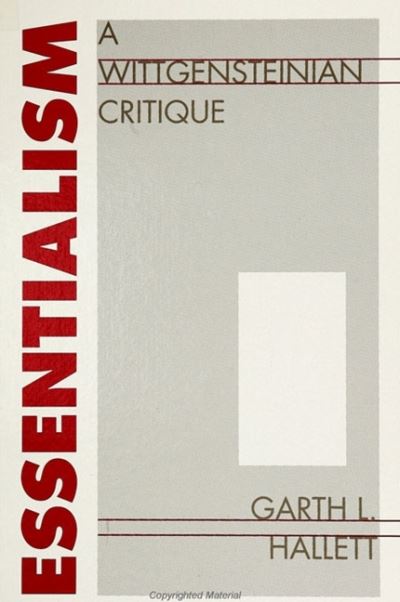
Argues that many philosophical commitments to hidden "essences" are based on misunderstandings of language, and that Wittgenstein's view of meaning as use dissolves these essentialist assumptions across logic, epistemology, and metaphysics.
What if much of contemporary philosophy rests on a mistake about language?
In Essentialism, Garth L. Hallett mounts a sustained and wide-ranging challenge to the assumption that things in the world must share hidden "essences" in order for our concepts to meaningfully apply. Drawing on Ludwig Wittgenstein's insights into language, use, and meaning, Hallett argues that much of modern essentialist thinking stems not from discovery, but from a misunderstanding of how language actually works.
Across seven tightly argued chapters, the book traces the rise, persistence, and transformation of essentialist thought-from classical and medieval analogies to contemporary debates in epistemology, philosophy of language, and modal metaphysics. Figures such as Kripke, Gettier, Dretske, and Carnap are engaged critically, alongside broader patterns in philosophical reasoning that continue to reintroduce essentialist assumptions under new forms.
Hallett not only diagnoses these recurring confusions but also asks why they remain so resilient. His answer is both philosophical and therapeutic: the problem is not simply that essentialism is false, but that certain entrenched habits of thought make it feel unavoidable.
Engaging, methodical, and philosophically provocative, this work challenges readers to reconsider what it means for concepts to have boundaries-and whether those boundaries were ever as fixed as philosophy has long assumed.
| ISBN: | 9780791407738 |
| Publication date: | 11th October 1991 |
| Author: | Garth L Hallett |
| Publisher: | SUNY Press an imprint of State University of New York Press |
| Format: | Hardback |
| Pagination: | 237 pages |
| Series: | SUNY Series in Logic and Language |
| Genres: |
Philosophy: epistemology and theory of knowledge Analytical philosophy and Logical Positivism Philosophy: metaphysics and ontology Philosophy of language Philosophical traditions and schools of thought Philosophy |
Argues that many philosophical commitments to hidden "essences" are based on misunderstandings of language, and that Wittgenstein's view of meaning as use dissolves these essentialist assumptions across logic, epistemology, and metaphysics.What if much of contemporary philosophy rests on a mistake about language?In Essentialism, Garth L. Hallett mounts a sustained and wide-ranging challenge to the assumption that things in the world must share hidden "essences" in order for our concepts to meaningfully apply.
Essentialism features in the following genres: Philosophy: epistemology and theory of knowledge, Analytical philosophy and Logical Positivism, Philosophy: metaphysics and ontology, Philosophy of language, Philosophical traditions and schools of thought, Philosophy
Hardback. Not Available.
Essentialism was written by Garth L Hallett and published by SUNY Press an imprint of State University of New York Press
Essentialism has 237 pages
Yes it is part of SUNY Series in Logic and Language series