

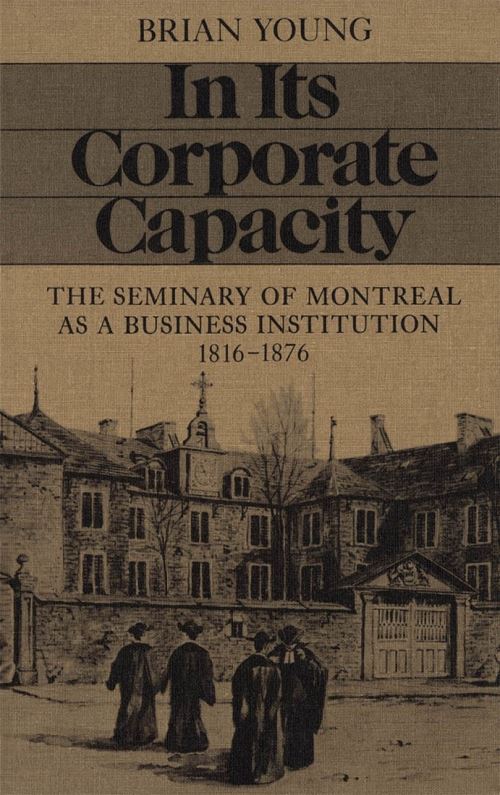
The end of the Lower Canada rebellions of 1837-8 assured the survival of the Seminary. Assuming a reinforced social and ideological role in industrializing Montreal, the Seminary benefited from new corporate powers, rights of recruitment, and income, while its expanding social role ensured its protection by an appreciate bourgeoisie. Emphasizing economic rather than religious history, Brian Young's study compares the Seminary's pre-industrial forms of income to its new capitalist revenues from land sales, subdivision developments, bonds, and rentier income from office, warehousing, and urban-housing properties.
Its changing income required new forms of management and the priest-manager was eventually assisted by an accountant, architect, surveyor, clerk, and several notaries and lawyers. The Seminary played a central role in the development of popular schools in Montreal, and in financing and directing social institutions such as hospitals, newspapers, libraries, and national societies, the Seminary of Montreal legitimized the changing class structure of industrializing Montreal.
| ISBN: | 9780773505544 |
| Publication date: | 1st August 1986 |
| Author: | Brian Young |
| Publisher: | McGill-Queen's University Press |
| Format: | Hardback |
| Pagination: | 304 pages |
| Genres: |
History of the Americas Religious and spiritual figures |
The end of the Lower Canada rebellions of 1837-8 assured the survival of the Seminary. Assuming a reinforced social and ideological role in industrializing Montreal, the Seminary benefited from new corporate powers, rights of recruitment, and income, while its expanding social role ensured its protection by an appreciate bourgeoisie.
In Its Corporate Capacity features in the following genres: History of the Americas, Religious and spiritual figures
Hardback, Ebook. Not Available.
In Its Corporate Capacity was written by Brian Young and published by McGill-Queen's University Press
In Its Corporate Capacity has 304 pages