

Viewed as ideal types, the Halakhah defines the norm, setting forth what is obligatory, the Aggadah, specifies what exceeds the norm and goes beyond the measure of the law. The striking differences of style and substance that differentiate the two categories of discourse present the question of how they intersect in a single coherent statement, a system that holds together its two distinct media of thought and expression.
When we have in hand systematic data on how Aggadah contributes to the Halakhah, and where Halakhah serves the purposes of the Aggadah, we find possible the logical next step: where do the two intersect, and at what points do the respective complexes of category-formations stand autonomous of one another, and that leads to the question: how do Aggadah and Halakhah constitute a coherent religious structure and make in common a single systemic statement?
Where, within the formative literature of Normative Judaism, they join together, what affect the one exercises upon the other, and how the whole - Rabbinic Judaism - exceeds and transcends the sum of the parts - the Halakhah, the Aggadah - is spelled out.
| ISBN: | 9780761819271 |
| Publication date: | 7th February 2001 |
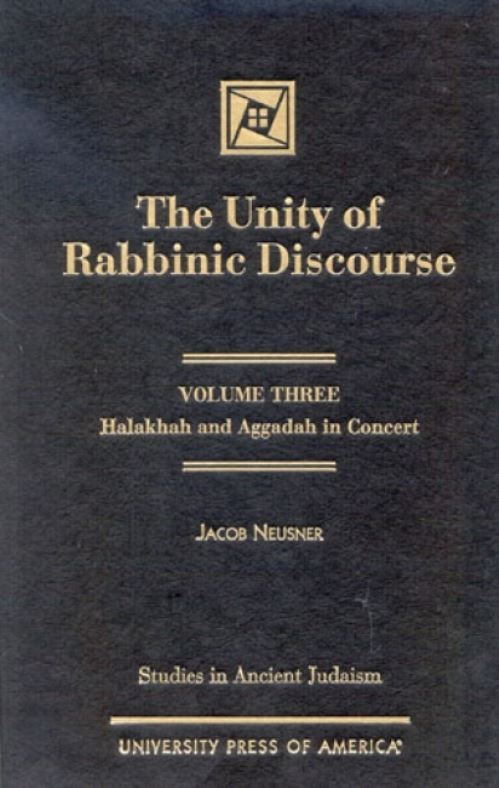
| Author: | Jacob Neusner |
| Publisher: | University Publishing Association an imprint of UPA |
| Format: | Hardback |
| Pagination: | 168 pages |
| Series: | Studies in Judaism |
| Genres: |
Judaism |
Viewed as ideal types, the Halakhah defines the norm, setting forth what is obligatory, the Aggadah, specifies what exceeds the norm and goes beyond the measure of the law. The striking differences of style and substance that differentiate the two categories of discourse present the question of how they intersect in a single coherent statement, a system that holds together its two distinct media of thought and expression.
The Unity of Rabbinic Discourse features in the following genres: Judaism
Hardback. Not Available.
The Unity of Rabbinic Discourse was written by Jacob Neusner and published by University Publishing Association an imprint of UPA
The Unity of Rabbinic Discourse has 168 pages
Yes it is part of Studies in Judaism series