

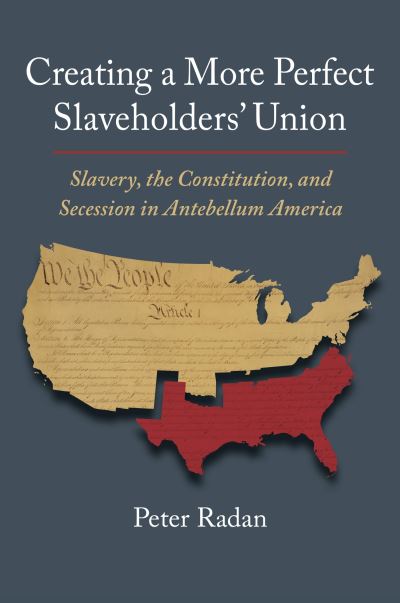
In Texas v. White (1869), the Supreme Court of the United States ruled that the unilateral secession of a state from the Union was unconstitutional because the Constitution created “an indestructible Union, composed of indestructible States.” The Court ruled “there was no place for reconsideration, or revocation, except through revolution, or through consent of the States.” In his iconoclastic work, Peter Radan demonstrates why the Court's ruling was wrong and why, on the basis of American constitutional law in 1860–1861, the unilateral secessions of the Confederate states were lawful on the grounds that the United States was forged as a “slaveholders' Union.”
Creating a More Perfect Slaveholders' Union addresses two constitutional issues: first, whether the states in 1860 had a right to secede from the Union and second, what significance slavery had in defining the constitutional Union. These two matters came together when the states seceded on the grounds that the system of government they had agreed to—namely, a system of human enslavement—had been violated by the incoming Republican administration. The legitimacy of this secession was anchored, as Radan demonstrates, in the compact theory of the Constitution, which held that because the Constitution was a compact between the member states of the Union, breaches of its fundamental provisions gave affected states the right to unilaterally secede from the Union. In so doing the Confederate states sought to preserve and protect their peculiar institution by forming a more perfect slaveholders' Union.
Creating a More Perfect Slaveholders' Union stands as the first and only systematic analysis of the legal arguments mounted for and against secession in 1860–1861 and reshapes how we understand the Civil War and, consequently, the history of the United States more generally.
| ISBN: | 9780700635801 |
| Publication date: | 31st October 2023 |
| Author: | Peter Radan |
| Publisher: | University Press of Kansas |
| Format: | Hardback |
| Pagination: | 448 pages |
| Series: | Constitutional Thinking |
| Genres: |
Legal history Civil wars Early modern warfare (including gunpowder warfare) Constitutional and administrative law: general |
In Texas v. White (1869), the Supreme Court of the United States ruled that the unilateral secession of a state from the Union was unconstitutional because the Constitution created “an indestructible Union, composed of indestructible States.” The Court ruled “there was no place for reconsideration, or revocation, except through revolution, or through consent of the States.” In his iconoclastic work, Peter Radan demonstrates why the Court's ruling was wrong and why, on the basis of American constitutional law in 1860–1861, the unilateral secessions of the Confederate states were lawful on the grounds that the United States was forged as a “slaveholders' Union.”
Creating a More Perfect Slaveholders' Union addresses two constitutional issues: first, whether the states in 1860 had a right to secede from the Union and second, what significance slavery had in defining the constitutional Union. These two matters came together when the states seceded on the grounds that the system of government they had agreed to—namely, a system of human enslavement—had been violated by the incoming Republican administration. The legitimacy of this secession was anchored, as Radan demonstrates, in the compact theory of the Constitution, which held that because the Constitution was a compact between the member states of the Union, breaches of its fundamental provisions gave affected states the right to unilaterally secede from the Union. In so doing the Confederate states sought to preserve and protect their peculiar institution by forming a more perfect slaveholders' Union.
Creating a More Perfect Slaveholders' Union stands as the first and only systematic analysis of the legal arguments mounted for and against secession in 1860–1861 and reshapes how we understand the Civil War and, consequently, the history of the United States more generally.
Creating a More Perfect Slaveholders' Union features in the following genres: Legal history, Civil wars, Early modern warfare (including gunpowder warfare), Constitutional and administrative law: general
Creating a More Perfect Slaveholders' Union is available in Hardback
Creating a More Perfect Slaveholders' Union was written by Peter Radan and published by University Press of Kansas
Creating a More Perfect Slaveholders' Union has 448 pages
Yes it is part of Constitutional Thinking series