

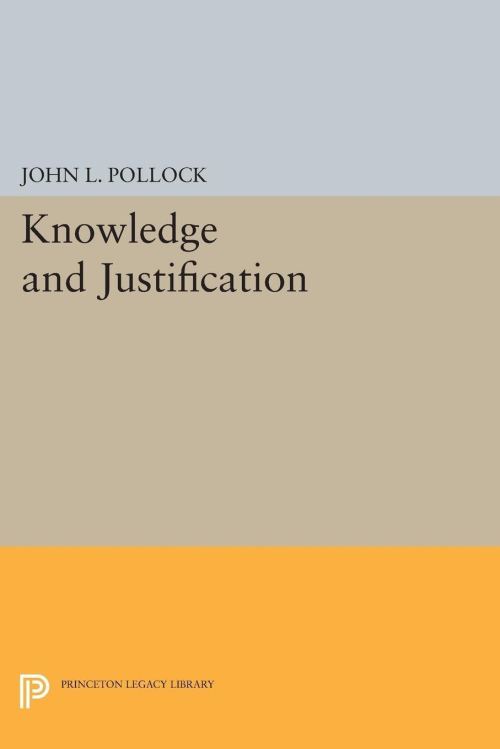
One of the most firmly entrenched beliefs of contemporary philosophy is that the only way to analyze a concept is to state its truth conditions. In epistemology this has led to the search for reductive analyses, to phenomenalism, behaviorism, and their analogues in other areas of knowledge. Arguing that these attempts at reductive analysis have invariably failed, John L. Pollock defends an alternative theory of conceptual analysis in this book.
The author suggests that concepts should be analyzed in terms of their justification conditions rather than their truth conditions. After laying a theoretical foundation for this alternative scheme of analysis, Professor Pollock applies his theory in proposing solutions to a number of traditional epistemological problems. Among the areas of knowledge discussed are perception, knowledge of the past, induction, knowledge of other minds, and a priori knowledge.
Originally published in 1975.
The Princeton Legacy Library uses the latest print-on-demand technology to again make available previously out-of-print books from the distinguished backlist of Princeton University Press. These editions preserve the original texts of these important books while presenting them in durable paperback and hardcover editions. The goal of the Princeton Legacy Library is to vastly increase access to the rich scholarly heritage found in the thousands of books published by Princeton University Press since its founding in 1905.
| ISBN: | 9780691645285 |
| Publication date: | 12th October 2018 |
| Author: | John L Pollock |
| Publisher: | Princeton University Press |
| Format: | Hardback |
| Pagination: | 362 pages |
| Series: | Princeton Legacy Library |
| Genres: |
Child, developmental and lifespan psychology |
One of the most firmly entrenched beliefs of contemporary philosophy is that the only way to analyze a concept is to state its truth conditions. In epistemology this has led to the search for reductive analyses, to phenomenalism, behaviorism, and their analogues in other areas of knowledge.
Knowledge and Justification features in the following genres: Child, developmental and lifespan psychology
Hardback, Paperback. Not Available.
Knowledge and Justification was written by John L Pollock and published by Princeton University Press
Knowledge and Justification has 362 pages
Yes it is part of Princeton Legacy Library series