

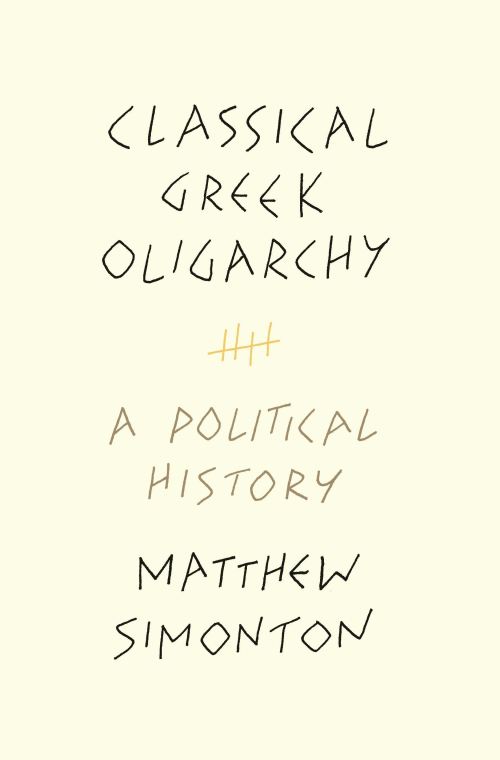
Classical Greek Oligarchy thoroughly reassesses an important but neglected form of ancient Greek government, the "rule of the few." Matthew Simonton challenges scholarly orthodoxy by showing that oligarchy was not the default mode of politics from time immemorial, but instead emerged alongside, and in reaction to, democracy. He establishes for the first time how oligarchies maintained power in the face of potential citizen resistance. The book argues that oligarchs designed distinctive political institutions-such as intra-oligarchic power sharing, targeted repression, and rewards for informants-to prevent collective action among the majority population while sustaining cooperation within their own ranks.
To clarify the workings of oligarchic institutions, Simonton draws on recent social science research on authoritarianism. Like modern authoritarian regimes, ancient Greek oligarchies had to balance coercion with co-optation in order to keep their subjects disorganized and powerless. The book investigates topics such as control of public space, the manipulation of information, and the establishment of patron-client relations, frequently citing parallels with contemporary nondemocratic regimes. Simonton also traces changes over time in antiquity, revealing the processes through which oligarchy lost the ideological battle with democracy for legitimacy.
Classical Greek Oligarchy represents a major new development in the study of ancient politics. It fills a longstanding gap in our knowledge of nondemocratic government while greatly improving our understanding of forms of power that continue to affect us today.
| ISBN: | 9780691174976 |
| Publication date: | 30th June 2017 |
| Author: | Matthew Simonton |
| Publisher: | Princeton University Press |
| Format: | Hardback |
| Pagination: | 376 pages |
| Genres: |
Ancient history European history Political science and theory Political ideologies and movements |
Classical Greek Oligarchy thoroughly reassesses an important but neglected form of ancient Greek government, the "rule of the few." Matthew Simonton challenges scholarly orthodoxy by showing that oligarchy was not the default mode of politics from time immemorial, but instead emerged alongside, and in reaction to, democracy. He establishes for the first time how oligarchies maintained power in the face of potential citizen resistance.
Classical Greek Oligarchy features in the following genres: Ancient history, European history, Political science and theory, Political ideologies and movements
Paperback, Hardback, Ebook. Not Available.
Classical Greek Oligarchy was written by Matthew Simonton and published by Princeton University Press
Classical Greek Oligarchy has 376 pages