

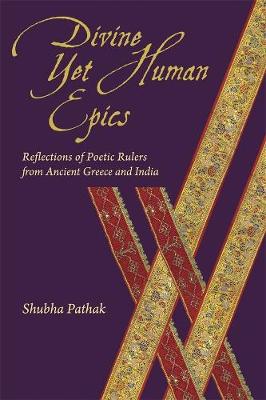
The central character of Divine Yet Human Epics is the developing conception of epic itself. Its story unfolds as the ancient Greek idea of epic originates with Pindar and Herodotus on the basis of the Iliad and Odyssey. While this notion eventually leads their Sanskrit counterparts, the Ramaya?a and Mahabharata, to be understood selectively in modern times, medieval readers Anandavardhana and Rajasekhara reveal distinctive features of these ancient Indian poems earlier in this exegetical tale.
Shubha Pathak's interpretative account concludes with a new way to connect these primary epics to their Greek analogues. Both epic pairs feature poetic kings who together affirm and interrogate their societies' central religious ideals: Greek kléos (or heroic glory, which assuages uncertainty about the afterlife) and Indian dharma (or righteousness, which counters encroaching immorality). The Greek and Sanskrit epics, by showing both the divine ease and the human difficulty with which kléos and dharma are achieved, employ similar teaching strategies to address the shared psychological needs of human beings learning to live within the disparate cultures of ancient Greece and India.
This cross-cultural comparative study thus provides a more comprehensive perspective on the poems' religiosity than the vantage points of Hellenists or of Indologists alone.
| ISBN: | 9780674726758 |
| Publication date: | 17th November 2014 |
| Author: | Shubha Pathak |
| Publisher: | Harvard University, Center for Hellenic Studies |
| Format: | Paperback |
| Pagination: | 222 pages |
| Series: | Hellenic Studies Series |
| Genres: |
Literary studies: poetry and poets Literary studies: ancient, classical and medieval |
The central character of Divine Yet Human Epics is the developing conception of epic itself. Its story unfolds as the ancient Greek idea of epic originates with Pindar and Herodotus on the basis of the Iliad and Odyssey.
Divine Yet Human Epics features in the following genres: Literary studies: poetry and poets, Literary studies: ancient, classical and medieval
Paperback. Not Available.
Divine Yet Human Epics was written by Shubha Pathak and published by Harvard University, Center for Hellenic Studies
Divine Yet Human Epics has 222 pages
Yes it is part of Hellenic Studies Series series