

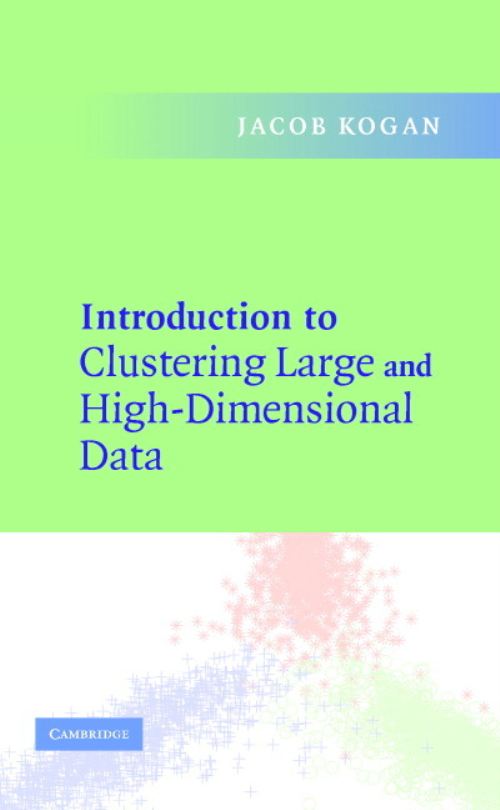
There is a growing need for a more automated system of partitioning data sets into groups, or clusters. For example, digital libraries and the World Wide Web continue to grow exponentially, the ability to find useful information increasingly depends on the indexing infrastructure or search engine. Clustering techniques can be used to discover natural groups in data sets and to identify abstract structures that might reside there, without having any background knowledge of the characteristics of the data.
Clustering has been used in a variety of areas, including computer vision, VLSI design, data mining, bio-informatics (gene expression analysis), and information retrieval, to name just a few. This book focuses on a few of the most important clustering algorithms, providing a detailed account of these major models in an information retrieval context. The beginning chapters introduce the classic algorithms in detail, while the later chapters describe clustering through divergences and show recent research for more advanced audiences.
| ISBN: | 9780521852678 |
| Publication date: | 13th November 2006 |
| Author: | Jacob Kogan |
| Publisher: | Cambridge University Press |
| Format: | Hardback |
| Pagination: | 205 pages |
| Genres: |
Data mining Probability and statistics Pattern recognition |
There is a growing need for a more automated system of partitioning data sets into groups, or clusters. For example, digital libraries and the World Wide Web continue to grow exponentially, the ability to find useful information increasingly depends on the indexing infrastructure or search engine.
Introduction to Clustering Large and High-Dimensional Data features in the following genres: Data mining, Probability and statistics, Pattern recognition
Ebook, Hardback. Not Available.
Introduction to Clustering Large and High-Dimensional Data was written by Jacob Kogan and published by Cambridge University Press
Introduction to Clustering Large and High-Dimensional Data has 205 pages