

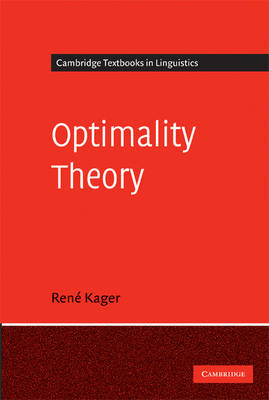
This is an introduction to Optimality Theory, whose central idea is that surface forms of language reflect resolutions of conflicts between competing constraints. A surface form is 'optimal' if it incurs the least serious violations of a set of constraints, taking into account their hierarchical ranking. Languages differ in the ranking of constraints; and any violations must be minimal.
The book does not limit its empirical scope to phonological phenomena, but also contains chapters on the learnability of OT grammars; OT's implications for syntax; and other issues such as opacity. It also reviews in detail a selection of the considerable research output which OT has already produced. Exercises accompany chapters 1-7, and there are sections on further reading.
Optimality Theory will be welcomed by any linguist with a basic knowledge of derivational Generative Phonology.
| ISBN: | 9780521589802 |
| Publication date: | 28th June 1999 |
| Author: | Rene Universiteit Utrecht, The Netherlands Kager |
| Publisher: | Cambridge University Press |
| Format: | Paperback |
| Pagination: | 466 pages |
| Series: | Cambridge Textbooks in Linguistics |
| Genres: |
Grammar, syntax and morphology |
This is an introduction to Optimality Theory, whose central idea is that surface forms of language reflect resolutions of conflicts between competing constraints. A surface form is 'optimal' if it incurs the least serious violations of a set of constraints, taking into account their hierarchical ranking.
Optimality Theory features in the following genres: Grammar, syntax and morphology
Hardback, Paperback. Not Available.
Optimality Theory was written by Rene Universiteit Utrecht, The Netherlands Kager and published by Cambridge University Press
Optimality Theory has 466 pages
Yes it is part of Cambridge Textbooks in Linguistics series