

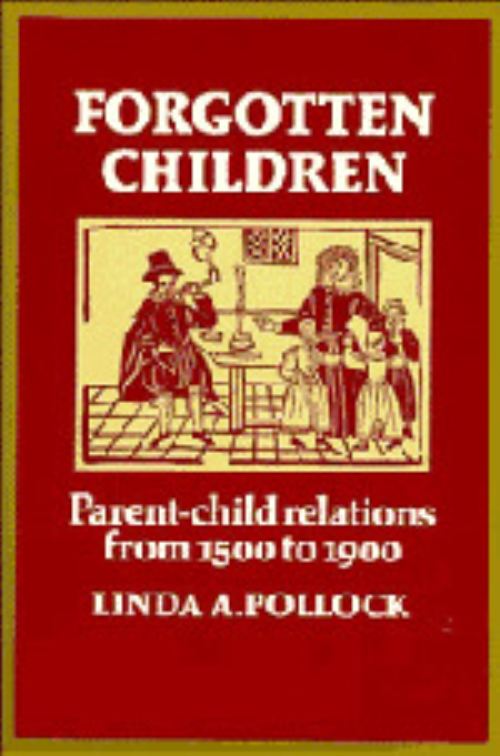
'The history of childhood is an area so full of errors, distortion and misinterpretation that I thought it vital, if progress were to be made, to supply a clear review of the information on childhood contained in such sources as diaries and autobiographies.' Dr Pollock's statement in her Preface will startle readers who have not questioned the validity of recent theories on the evolution of childhood and the treatment of children, theories which see a movement from a situation where the concept of childhood was almost absent, and children were cruelly treated, to our present western recognition that children are different and should be treated with love and affection.
Linda examines this thesis particularly through the close and careful analysis of some hundreds of English and American primary sources. Through these sources, she has been able to reconstruct, probably for the first time, a genuine picture of childhood in the past, and it is a much more humane and optimistic picture than the current stereotype. Her book contains a mass of novel and original material on child-rearing practices and the relations of parents and children, and sets this in the wider framework of developmental psychology, socio-biology and social anthropology.
Forgotten Children admirably fulfils the aim of its author. In the face of this scholarly and elegant account of the continuity of parental care, few will now be able to argue for dramatic transformations in the twentieth century.
| ISBN: | 9780521250092 |
| Publication date: | 24th November 1983 |
| Author: | Linda A Pollock |
| Publisher: | Cambridge University Press |
| Format: | Hardback |
| Pagination: | 334 pages |
| Genres: |
Child, developmental and lifespan psychology |
'The history of childhood is an area so full of errors, distortion and misinterpretation that I thought it vital, if progress were to be made, to supply a clear review of the information on childhood contained in such sources as diaries and autobiographies.' Dr Pollock's statement in her Preface will startle readers who have not questioned the validity of recent theories on the evolution of childhood and the treatment of children, theories which see a movement from a situation where the concept of childhood was almost absent, and children were cruelly treated, to our present western recognition that children are different and should be treated with love and affection. Linda examines this thesis particularly through the close and careful analysis of some hundreds of English and American primary sources.
Forgotten Children features in the following genres: Child, developmental and lifespan psychology
Hardback, Paperback. Not Available.
Forgotten Children was written by Linda A Pollock and published by Cambridge University Press
Forgotten Children has 334 pages