

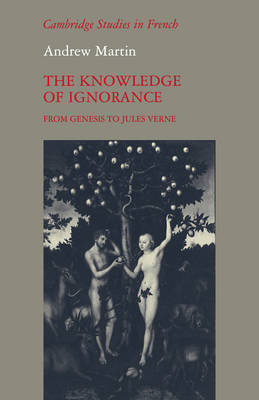
This highly original study is concerned with the theory of knowledge. It approaches the subject in a new way by exploring the recurrent paradox which equates pure ignorance with perfect knowledge, twin ideals free from the impurities and imperfections of discourse. The author combines the techniques of literary criticism and intellectual history in order to examine the literary, philosophical, theological, and political ramifications of this anxiety about, and ambition to transcend, the limits of the text. Dr Martin begins by tracing a network of interlocking motifs and images - beginning and end, nescience and omniscience, genesis and renascence, savagery and civilization - across a broad spectrum of texts from the Book of Genesis through the Renaissance (in particular the works of Nicholas of Cusa and Erasmus) to Rousseau. The central section of the book translates these temporal oppositions into the spatial antithesis of East and West in the Orientalism of Hugo, Napoleon and Chateaubriand. A final chapter draws together these apparently disparate themes in a consideration of the dichotomy of science and literature in Jules Verne's Voyages Extraordinaires.
| ISBN: | 9780521112482 |
| Publication date: | 4th June 2009 |
| Author: | Andrew Martin |
| Publisher: | Cambridge University Press |
| Format: | Paperback |
| Pagination: | 272 pages |
| Series: | Cambridge Studies in French |
| Genres: |
Literary studies: general |
This highly original study is concerned with the theory of knowledge. It approaches the subject in a new way by exploring the recurrent paradox which equates pure ignorance with perfect knowledge, twin ideals free from the impurities and imperfections of discourse. The author combines the techniques of literary criticism and intellectual history in order to examine the literary, philosophical, theological, and political ramifications of this anxiety about, and ambition to transcend, the limits of the text. Dr Martin begins by tracing a network of interlocking motifs and images - beginning and end, nescience and omniscience, genesis and renascence, savagery and civilization - across a broad spectrum of texts from the Book of Genesis through the Renaissance (in particular the works of Nicholas of Cusa and Erasmus) to Rousseau. The central section of the book translates these temporal oppositions into the spatial antithesis of East and West in the Orientalism of Hugo, Napoleon and Chateaubriand. A final chapter draws together these apparently disparate themes in a consideration of the dichotomy of science and literature in Jules Verne's Voyages Extraordinaires.
The Knowledge of Ignorance features in the following genres: Literary studies: general
The Knowledge of Ignorance is available in Paperback, Hardback
The Knowledge of Ignorance was written by Andrew Martin and published by Cambridge University Press
The Knowledge of Ignorance has 272 pages
Yes it is part of Cambridge Studies in French series
£30.60