

Leadership has long been an important subject in the study of international economic relations. Many scholars give American leadership credit for strong economic growth in western Europe and Japan after World War II. Other scholars have accused leading nations of using their power to the detriment of foreign countries. For example, it is often argued that a failure of both British and American leadership was a cause of the Great Depression of the 1930s.
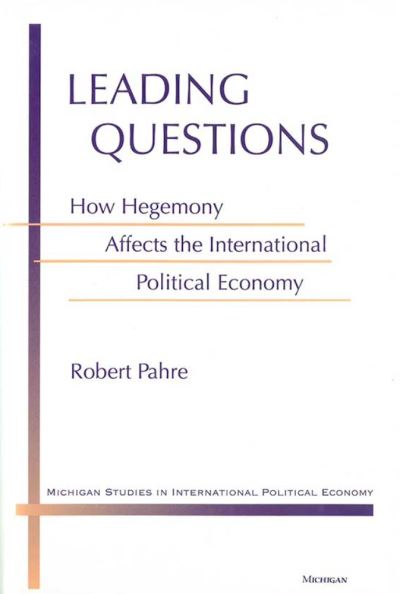
In Leading Questions, Robert Pahre develops a series of formal models to determine under what conditions leadership will be beneficial or harmful for the international political economy. He begins with a simple model of collective action and then adds leadership, security concerns, cooperation, and multilateral regimes to this basic model. He tests each model against a different historical period between 1815 and 1967.
Pahre's findings challenge conventional wisdom on international leadership. He finds that a leading state harms others when it has many allies but is good for the international political economy when it lacks allies. Leaders are less likely to engage in international cooperation than are other states, but having a leader in the system makes cooperation among follower states more likely. Cooperation by others may cause the leader to join a system of multilateral cooperation.
Pahre presents the technical material in an accessible style. By challenging the conventional interpretations of political economy in several historical periods, Leading Questions will be of interest not only to political scientists but also to economists and historians.
Robert Pahre is Associate Professor of Political Science, University of Illinois at Urbana-Champaign.
| ISBN: | 9780472109708 |
| Publication date: | 2nd April 1999 |
| Author: | Robert Pahre |
| Publisher: | The University of Michigan Press an imprint of University of Michigan Press |
| Format: | Hardback |
| Pagination: | 277 pages |
| Series: | Michigan Studies in International Political Economy |
| Genres: |
Central / national / federal government policies Political economy |
Leadership has long been an important subject in the study of international economic relations. Many scholars give American leadership credit for strong economic growth in western Europe and Japan after World War II. Other scholars have accused leading nations of using their power to the detriment of foreign countries. For example, it is often argued that a failure of both British and American leadership was a cause of the Great Depression of the 1930s.
In Leading Questions, Robert Pahre develops a series of formal models to determine under what conditions leadership will be beneficial or harmful for the international political economy. He begins with a simple model of collective action and then adds leadership, security concerns, cooperation, and multilateral regimes to this basic model. He tests each model against a different historical period between 1815 and 1967.
Pahre's findings challenge conventional wisdom on international leadership. He finds that a leading state harms others when it has many allies but is good for the international political economy when it lacks allies. Leaders are less likely to engage in international cooperation than are other states, but having a leader in the system makes cooperation among follower states more likely. Cooperation by others may cause the leader to join a system of multilateral cooperation.
Pahre presents the technical material in an accessible style. By challenging the conventional interpretations of political economy in several historical periods, Leading Questions will be of interest not only to political scientists but also to economists and historians.
Robert Pahre is Associate Professor of Political Science, University of Illinois at Urbana-Champaign.
Leading Questions features in the following genres: Central / national / federal government policies, Political economy
Leading Questions is available in Hardback
Leading Questions was written by Robert Pahre and published by The University of Michigan Press an imprint of University of Michigan Press
Leading Questions has 277 pages
Yes it is part of Michigan Studies in International Political Economy series