

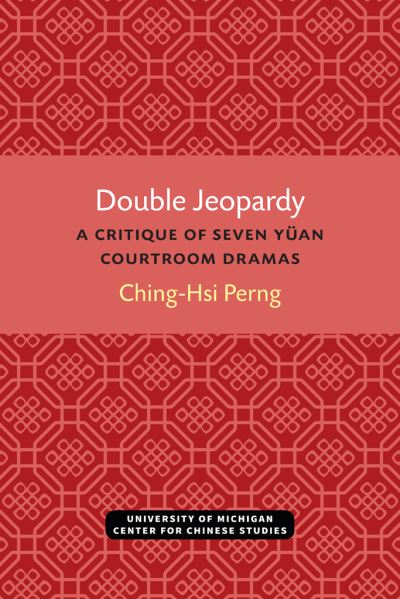
Traditionally, criticism of plays from the Yüan Dynasty (1260-1368) has been dominated by the so-called poetic and socialist schools. Double Jeopardy instead rigorously evaluates a group of plays by aesthetic criteria generated from within the works themselves. It examines seven courtroom plays with special attention to language and the manipulation of dramatic characters-undoubtedly the most reliable indicators of the playwright's strength and craftsmanship in such a stylized art form as Yüan tsa-chü drama. The analytical method adopted in Double Jeopardy is textual explication of the conventions of genre and the individual characteristics of each play. The innovation and creative vitality of each playwright emerges through close scrutiny of selected conventional aspects of courtroom dramas: the functions and placement patterns of lyric, verse, and prose as well as the custom of a single singing role and its implication for the presentation of dramatis personae. Because Yüan drama is driven by conventions, Perng demonstrates a method that can be applied not just to judgment reversal plays but to Yüan dramatic criticism as a whole. In pursuing a method of textual explication, Perng provides a basis on which a larger framework of criticism of Yüan drama may be built.
| ISBN: | 9780472037995 |
| Publication date: | 1st January 1978 |
| Author: | ChingHsi Perng |
| Publisher: | University of Michigan, Center for Chinese Studies an imprint of University of Michigan Press |
| Format: | Paperback |
| Pagination: | 178 pages |
| Series: | Michigan Monographs in Chinese Studies |
| Genres: |
Language: reference and general |
Traditionally, criticism of plays from the Yüan Dynasty (1260-1368) has been dominated by the so-called poetic and socialist schools. Double Jeopardy instead rigorously evaluates a group of plays by aesthetic criteria generated from within the works themselves.
Double Jeopardy features in the following genres: Language: reference and general
Paperback. Not Available.
Double Jeopardy was written by ChingHsi Perng and published by University of Michigan, Center for Chinese Studies an imprint of University of Michigan Press
Double Jeopardy has 178 pages
Yes it is part of Michigan Monographs in Chinese Studies series