

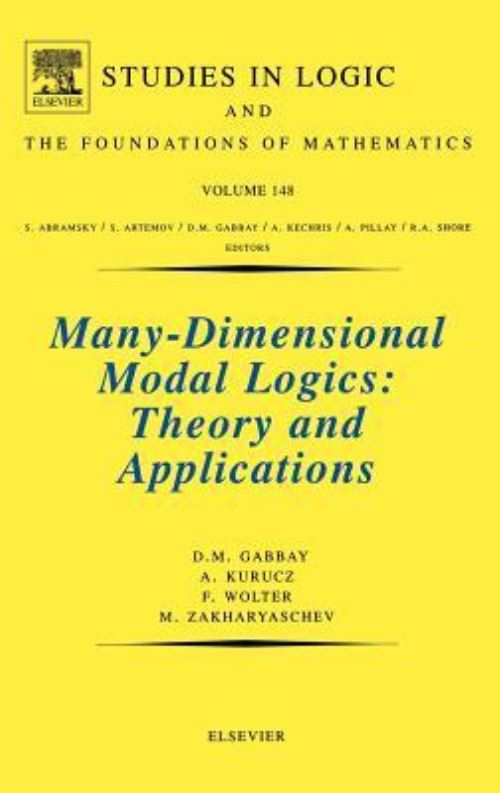
Modal logics, originally conceived in philosophy, have recently found many applications in computer science, artificial intelligence, the foundations of mathematics, linguistics and other disciplines. Celebrated for their good computational behaviour, modal logics are used as effective formalisms for talking about time, space, knowledge, beliefs, actions, obligations, provability, etc. However, the nice computational properties can drastically change if we combine some of these formalisms into a many-dimensional system, say, to reason about knowledge bases developing in time or moving objects.
To study the computational behaviour of many-dimensional modal logics is the main aim of this book. On the one hand, it is concerned with providing a solid mathematical foundation for this discipline, while on the other hand, it shows that many seemingly different applied many-dimensional systems (e.g., multi-agent systems, description logics with epistemic, temporal and dynamic operators, spatio-temporal logics, etc.) fit in perfectly with this theoretical framework, and so their computational behaviour can be analyzed using the developed machinery.
We start with concrete examples of applied one- and many-dimensional modal logics such as temporal, epistemic, dynamic, description, spatial logics, and various combinations of these. Then we develop a mathematical theory for handling a spectrum of 'abstract' combinations of modal logics - fusions and products of modal logics, fragments of first-order modal and temporal logics - focusing on three major problems: decidability, axiomatizability, and computational complexity. Besides the standard methods of modal logic, the technical toolkit includes the method of quasimodels, mosaics, tilings, reductions to monadic second-order logic, algebraic logic techniques. Finally, we apply the developed machinery and obtained results to three case studies from the field of knowledge representation and reasoning: temporal epistemic logics for reasoning about multi-agent systems, modalized description logics for dynamic ontologies, and spatio-temporal logics.
The genre of the book can be defined as a research monograph. It brings the reader to the front line of current research in the field by showing both recent achievements and directions of future investigations (in particular, multiple open problems). On the other hand, well-known results from modal and first-order logic are formulated without proofs and supplied with references to accessible sources.
The intended audience of this book is logicians as well as those researchers who use logic in computer science and artificial intelligence. More specific application areas are, e.g., knowledge representation and reasoning, in particular, terminological, temporal and spatial reasoning, or reasoning about agents. And we also believe that researchers from certain other disciplines, say, temporal and spatial databases or geographical information systems, will benefit from this book as well.
Key Features:
Integrated approach to modern modal and temporal logics and their applications in artificial intelligence and computer science
Written by internationally leading researchers in the field of pure and applied logic
Combines mathematical theory of modal logic and applications in artificial intelligence and computer science
Numerous open problems for further research
Well illustrated with pictures and tables
| ISBN: | 9780444508263 |
| Publication date: | 21st October 2003 |
| Author: | Dov M Gabbay |
| Publisher: | North Holland an imprint of Elsevier Science |
| Format: | Hardback |
| Pagination: | 747 pages |
| Series: | Studies in Logic and the Foundations of Mathematics |
| Genres: |
Computer science Mathematical logic Discrete mathematics Artificial intelligence |
Modal logics, originally conceived in philosophy, have recently found many applications in computer science, artificial intelligence, the foundations of mathematics, linguistics and other disciplines. Celebrated for their good computational behaviour, modal logics are used as effective formalisms for talking about time, space, knowledge, beliefs, actions, obligations, provability, etc.
Many-Dimensional Modal Logics features in the following genres: Computer science, Mathematical logic, Discrete mathematics, Artificial intelligence
Hardback. Not Available.
Many-Dimensional Modal Logics was written by Dov M Gabbay and published by North Holland an imprint of Elsevier Science
Many-Dimensional Modal Logics has 747 pages
Yes it is part of Studies in Logic and the Foundations of Mathematics series