

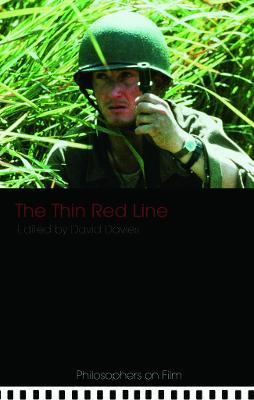
The Thin Red Line is the third feature-length film from acclaimed director Terrence Malick, set during the struggle between American and Japanese forces for Guadalcanal in the South Pacific during World War Two. It is a powerful, enigmatic and complex film that raises important philosophical questions, ranging from the existential and phenomenological to the artistic and technical. This is the first collection dedicated to exploring the philosophical aspects of Malick’s film.
Opening with a helpful introduction that places the film in context, five essays, four of which were specially commissioned for this collection, go on to examine the following: the exploration of Heideggerian themes – such as being-towards-death and the vulnerability of Dasein’s world – in The Thin Red Line how Malick’s film explores and cinematically expresses the embodied nature of our experience of, and agency in, the world Malick’s use of cinematic techniques, and how the style of his images shapes our affective, emotional, and cognitive responses to the film the role that images of nature play in Malick’s cinema, and his ‘Nietzschean’ conception of human nature.
The Thin Red Line is essential reading for students interested in philosophy and film or phenomenology and existentialism. It also provides an accessible and informative insight into philosophy for those in related disciplines such as film studies, literature and religion. Contributors: Simon Critchley, Hubert Dreyfus and Camilo Prince, David Davies, Amy Coplan, Iain Macdonald.
| ISBN: | 9780415773652 |
| Publication date: | 31st July 2008 |
| Author: | David Davies |
| Publisher: | Routledge an imprint of Taylor & Francis Ltd |
| Format: | Paperback |
| Pagination: | 116 pages |
| Series: | Philosophers on Film |
| Genres: |
Philosophy Films, cinema |
The Thin Red Line is the third feature-length film from acclaimed director Terrence Malick, set during the struggle between American and Japanese forces for Guadalcanal in the South Pacific during World War Two. It is a powerful, enigmatic and complex film that raises important philosophical questions, ranging from the existential and phenomenological to the artistic and technical.
The Thin Red Line features in the following genres: Philosophy, Films, cinema
Paperback, Hardback. £30.59, down from the £33.99 cover price. Not Available.
The Thin Red Line was written by David Davies and published by Routledge an imprint of Taylor & Francis Ltd
The Thin Red Line has 116 pages
Yes it is part of Philosophers on Film series
£30.59, reduced from £33.99. Not Available.