

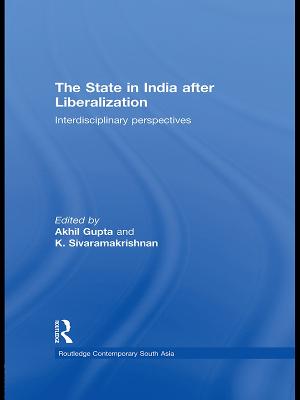
This book assesses the impact of liberalization on practices of government and relations between state and society. It is clear that liberalization as state policy has complex forms of regulation and deregulation inbuilt, and these policies have resulted in dramatic increases in productivity and economic wealth but also generated spectacular new forms of inequality between social groups, regions, and sectors. Through a detailed examination of the Indian state, the contributors - all experts in their respective fields - explore questions such as: Have the new inequalities resulted in greater social unrest and violence?
How has the meaning of citizenship changed? What will the long-term effects of regional economic imbalances be on migration, employment, and social welfare? Will increasing federalism result in new problems?
Will smaller governments be more effective in providing basic necessities such as clothing, housing, food, water, and sanitation to citizens? What does liberalization mean to Indians in cities and villages, in small towns, and metropolises, in poor, middle class, or wealthy homes? Are concepts like social capital, decentralization, private enterprise, and grass-roots globalization effective in analyzing the post-liberalization state, or are new concepts needed?
By focusing on what specifically has changed about the state after liberalization in India, this volume will shed light on comparative questions about the process of neoliberal restructuring across the world. As such, it will be of interest to scholars of a variety of disciplines, including sociology, anthropology, political science, geography, international studies, public policy, environmental studies and economics.
| ISBN: | 9780415631754 |
| Publication date: | 1st May 2012 |
| Author: | Akhil Gupta |
| Publisher: | Routledge an imprint of Taylor & Francis Ltd |
| Format: | Paperback |
| Pagination: | 240 pages |
| Series: | Routledge Contemporary South Asia Series |
| Genres: |
Economics Regional / International studies |
This book assesses the impact of liberalization on practices of government and relations between state and society. It is clear that liberalization as state policy has complex forms of regulation and deregulation inbuilt, and these policies have resulted in dramatic increases in productivity and economic wealth but also generated spectacular new forms of inequality between social groups, regions, and sectors.
The State in India after Liberalization features in the following genres: Economics, Regional / International studies
Paperback, Hardback. £45.89, down from the £50.99 cover price. Not Available.
The State in India after Liberalization was written by Akhil Gupta and published by Routledge an imprint of Taylor & Francis Ltd
The State in India after Liberalization has 240 pages
Yes it is part of Routledge Contemporary South Asia Series series
£45.89, reduced from £50.99. Not Available.