

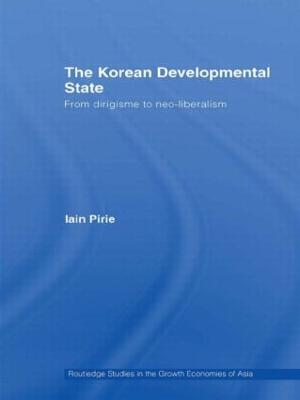
The Korean Developmental State is a comprehensive and up-to-date analysis of processes of state and economic restructuring in South Korea since the 1997 crisis. The book distinguishes itself from previous studies by consistently arguing that structural changes in the global political economy have played a crucial role in reshaping the Korean state’s own economic project. More precisely, Iain Pirie seeks to demonstrate how the Korean state increasingly adopted neo-liberal policies from the 1980s onwards as a rational response to the evolution of global economic structures; an evolution which has been driven by the continuous attempts of major global firms and leading capitalist states to overcome the chronic profitability problems that have dogged the core capitalist area since the late 1960s.
The radical restructuring programme the Korean state initiated after the 1997 crisis must be understood as a logical conclusion to these earlier, more incremental, processes of reform it initiated almost two decades earlier. This book seeks to establish the neo-liberal character of the Korean state through a close analysis of key institutional and policy reforms, and serious engagement with more theoretical debates concerning the nature of the neo-liberal state itself.
The Korean Developmental State offers a new perspective on the economic experience of Korea as a development model, one that emphasizes global trends and contradictions for Korea’s economic crisis and resulting transformation, and as such will be of significant interest to scholars of Korean studies and the Asian economy.
| ISBN: | 9780415547086 |
| Publication date: | 15th April 2009 |
| Author: | Iain Pirie |
| Publisher: | Routledge an imprint of Taylor & Francis Ltd |
| Format: | Paperback |
| Pagination: | 236 pages |
| Series: | Routledge Studies in the Growth Economies of Asia |
| Genres: |
Political economy Interdisciplinary studies |
The Korean Developmental State is a comprehensive and up-to-date analysis of processes of state and economic restructuring in South Korea since the 1997 crisis. The book distinguishes itself from previous studies by consistently arguing that structural changes in the global political economy have played a crucial role in reshaping the Korean state’s own economic project.
The Korean Developmental State features in the following genres: Political economy, Interdisciplinary studies
Paperback, Hardback. £55.79, down from the £61.99 cover price. Not Available.
The Korean Developmental State was written by Iain Pirie and published by Routledge an imprint of Taylor & Francis Ltd
The Korean Developmental State has 236 pages
Yes it is part of Routledge Studies in the Growth Economies of Asia series
£55.79, reduced from £61.99. Not Available.