

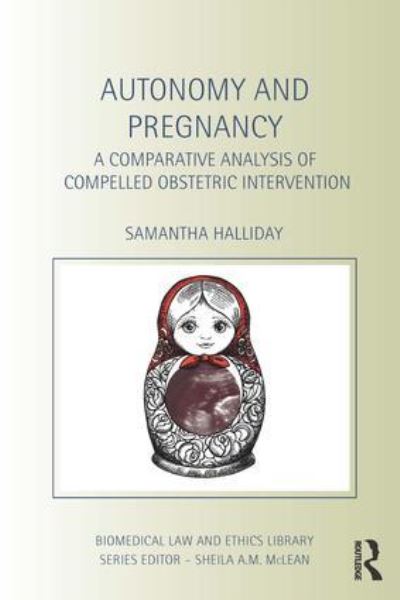
Technology has come to dominate the modern experience of pregnancy and childbirth, but instead of empowering pregnant women, technology has been used to identify the foetus as a second patient characterised as a distinct entity with its own needs and interests. Often, foetal and the woman's interests will be aligned, though in legal and medical discourses the two 'patients' are frequently framed as antagonists with conflicting interests.
This book focuses upon the permissibility of encroachment on the pregnant woman's autonomy in the interests of the foetus. Drawing on the law in England & Wales, the United States of America and Germany, Samantha Halliday focuses on the tension between a pregnant woman's autonomy and medical actions taken to protect the foetus, addressing circumstances in which courts have declared medical treatment lawful in the face of the pregnant woman's refusal of consent.
As a work which calls into question the understanding of autonomy in prenatal medical care, this book will be of great use and interest to students, researchers and practitioners in medical law, comparative law, bioethics, and human rights.
| ISBN: | 9780415423038 |
| Publication date: | 13th May 2016 |
| Author: | Sam Halliday |
| Publisher: | Routledge an imprint of Taylor & Francis |
| Format: | Paperback |
| Pagination: | 350 pages |
| Series: | Biomedical Law and Ethics Library |
| Genres: |
Medical and healthcare law Ethics and moral philosophy Comparative law |
Technology has come to dominate the modern experience of pregnancy and childbirth, but instead of empowering pregnant women, technology has been used to identify the foetus as a second patient characterised as a distinct entity with its own needs and interests. Often, foetal and the woman's interests will be aligned, though in legal and medical discourses the two 'patients' are frequently framed as antagonists with conflicting interests.
Reproductive Ethics and the Law features in the following genres: Medical and healthcare law, Ethics and moral philosophy, Comparative law
Paperback. £53.09, down from the £58.99 cover price. Not Available.
Reproductive Ethics and the Law was written by Sam Halliday and published by Routledge an imprint of Taylor & Francis
Reproductive Ethics and the Law has 350 pages
Yes it is part of Biomedical Law and Ethics Library series
£53.09, reduced from £58.99. Not Available.