

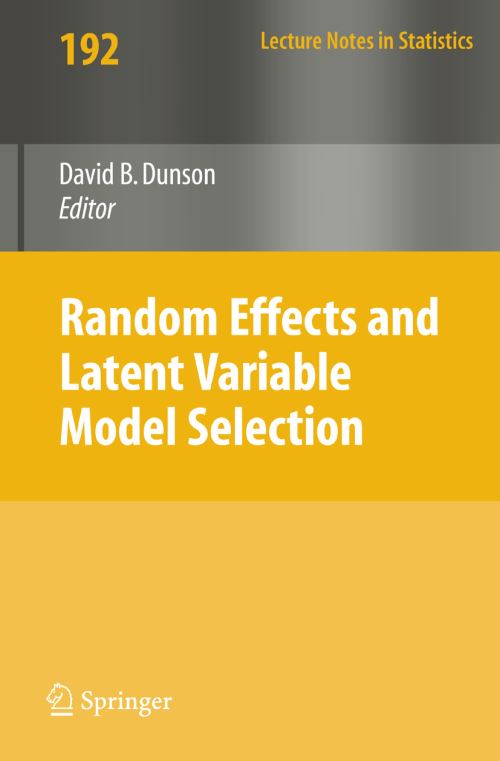
Random Effect and Latent Variable Model Selection In recent years, there has been a dramatic increase in the collection of multivariate and correlated data in a wide variety of ?elds. For example, it is now standard pr- tice to routinely collect many response variables on each individual in a study. The different variables may correspond to repeated measurements over time, to a battery of surrogates for one or more latent traits, or to multiple types of outcomes having an unknown dependence structure.
Hierarchical models that incorporate subje- speci?c parameters are one of the most widely-used tools for analyzing multivariate and correlated data. Such subject-speci?c parameters are commonly referred to as random effects, latent variables or frailties. There are two modeling frameworks that have been particularly widely used as hierarchical generalizations of linear regression models.
The ?rst is the linear mixed effects model (Laird and Ware , 1982) and the second is the structural equation model (Bollen , 1989). Linear mixed effects (LME) models extend linear regr- sion to incorporate two components, with the ?rst corresponding to ?xed effects describing the impact of predictors on the mean and the second to random effects characterizing the impact on the covariance. LMEs have also been increasingly used for function estimation.
In implementing LME analyses, model selection problems are unavoidable. For example, there may be interest in comparing models with and without a predictor in the ?xed and/or random effects component.
| ISBN: | 9780387767208 |
| Publication date: | 12th August 2008 |
| Author: | David B Dunson |
| Publisher: | Springer an imprint of Springer New York |
| Format: | Paperback |
| Pagination: | 169 pages |
| Series: | Lecture Notes in Statistics |
| Genres: |
Probability and statistics Stochastics |
Random Effect and Latent Variable Model Selection In recent years, there has been a dramatic increase in the collection of multivariate and correlated data in a wide variety of ?elds. For example, it is now standard pr- tice to routinely collect many response variables on each individual in a study.
Random Effect and Latent Variable Model Selection features in the following genres: Probability and statistics, Stochastics
Paperback. £40.49, down from the £44.99 cover price. Not Available.
Random Effect and Latent Variable Model Selection was written by David B Dunson and published by Springer an imprint of Springer New York
Random Effect and Latent Variable Model Selection has 169 pages
Yes it is part of Lecture Notes in Statistics series
£40.49, reduced from £44.99. Not Available.