

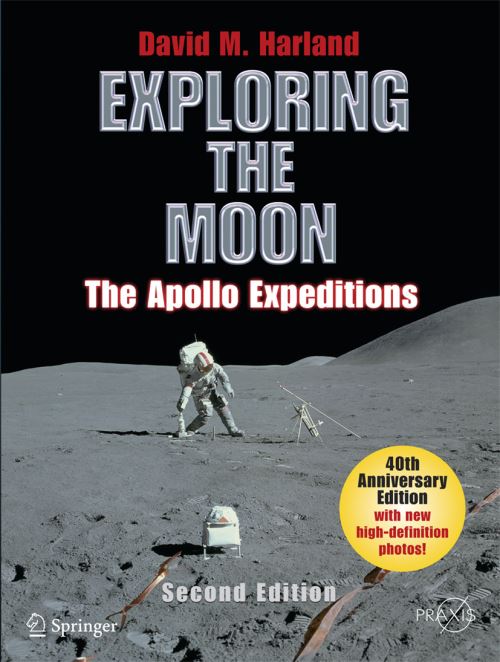
David Harland opens with a review of the robotic probes, namely the Rangers which returned television before crashing into the Moon, the Surveyors which 'soft landed' in order to investigate the nature of the surface, and the Lunar Orbiters which mapped prospective Apollo landing sites. He then outlines the historic landing by Apollo 11 in terms of what was discovered, and how over the next several missions the program was progressively geared up to enable the final three missions each to spend three days on comprehensive geological investigations. He concludes with a review of the robotic spacecraft that made remote-sensing observations of the Moon. Although aimed at the enthusiast, and can be read as an adventure in exploration, the book develops the scientific theme of lunar geology, and therefore will be of use as background reading for undergraduate students of planetary sciences. In addition, with the prospect of a resumption of human missions, it will help journalists understand what Apollo achieved after the 'flags and footprints' of the Apollo 11 landing in July 1969 and will commemorate the fortieth anniversary of that momentous event.
| ISBN: | 9780387746388 |
| Publication date: | 11th March 2008 |
| Author: | David M Harland |
| Publisher: | Praxis an imprint of Springer New York |
| Format: | Paperback |
| Pagination: | 403 pages |
| Series: | Springer Praxis Books |
| Genres: |
Astronomy, space and time Astronautics History of science Astronomical observation: observatories, equipment and methods Solar system: the Sun and planets Applied physics Aerospace and aviation technology |
David Harland opens with a review of the robotic probes, namely the Rangers which returned television before crashing into the Moon, the Surveyors which 'soft landed' in order to investigate the nature of the surface, and the Lunar Orbiters which mapped prospective Apollo landing sites. He then outlines the historic landing by Apollo 11 in terms of what was discovered, and how over the next several missions the program was progressively geared up to enable the final three missions each to spend three days on comprehensive geological investigations.
Exploring the Moon features in the following genres: Astronomy, space and time, Astronautics, History of science, Astronomical observation: observatories, equipment and methods, Solar system: the Sun and planets, Applied physics, Aerospace and aviation technology
Ebook, Paperback. £35.99, down from the £39.99 cover price. Not Available.
Exploring the Moon was written by David M Harland and published by Praxis an imprint of Springer New York
Exploring the Moon has 403 pages
Yes it is part of Springer Praxis Books series
£35.99, reduced from £39.99. Not Available.