

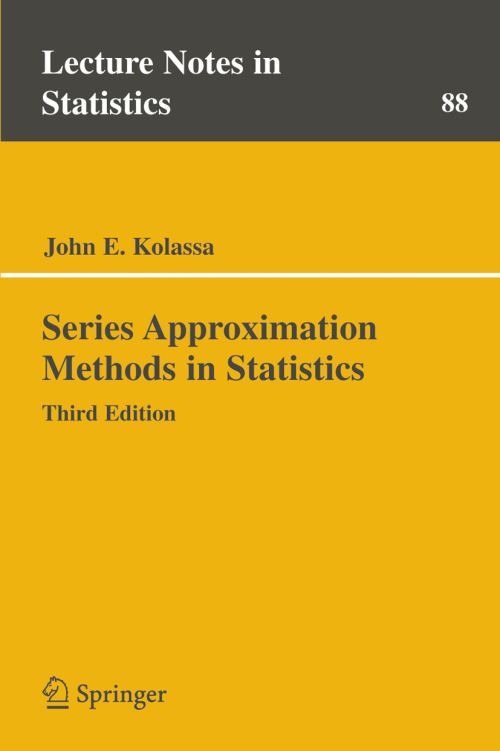
This book was originally compiled for a course I taught at the University of Rochester in the fall of 1991, and is intended to give advanced graduate students in statistics an introduction to Edgeworth and saddlepoint approximations, and related techniques. Many other authors have also written monographs on this s- ject, and so this work is narrowly focused on two areas not recently discussed in theoretical text books.
These areas are, ?rst, a rigorous consideration of Edgeworth and saddlepoint expansion limit theorems, and second, a survey of the more recent developments in the ?eld. In presenting expansion limit theorems I have drawn heavily on notation of McCullagh (1987) and on the theorems presented by Feller (1971) on Edgeworth expansions. For saddlepoint notation and results I relied most heavily on the many papers of Daniels, and a review paper by Reid (1988).
Throughout this book I have tried to maintain consistent notation and to present theorems in such a way as to make a few theoretical results useful in as many contexts as possible. This was not only in order to present as many results with as few proofs as possible, but more importantly to show the interconnections between the various facets of asymptotic theory. Special attention is paid to regularity conditions.
The reasons they are needed and the parts they play in the proofs are both highlighted.
| ISBN: | 9780387314099 |
| Publication date: | 28th April 2006 |
| Author: | John Edward Kolassa |
| Publisher: | Springer an imprint of Springer New York |
| Format: | Paperback |
| Pagination: | 218 pages |
| Series: | Lecture Notes in Statistics |
| Genres: |
Probability and statistics Applied mathematics |
This book was originally compiled for a course I taught at the University of Rochester in the fall of 1991, and is intended to give advanced graduate students in statistics an introduction to Edgeworth and saddlepoint approximations, and related techniques. Many other authors have also written monographs on this s- ject, and so this work is narrowly focused on two areas not recently discussed in theoretical text books.
Series Approximation Methods in Statistics features in the following genres: Probability and statistics, Applied mathematics
Paperback. £126.45, down from the £140.50 cover price. Not Available.
Series Approximation Methods in Statistics was written by John Edward Kolassa and published by Springer an imprint of Springer New York
Series Approximation Methods in Statistics has 218 pages
Yes it is part of Lecture Notes in Statistics series
£126.45, reduced from £140.50. Not Available.