

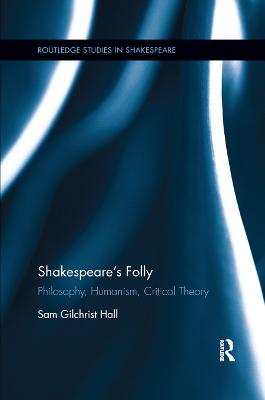
This study contends that folly is of fundamental importance to the implicit philosophical vision of Shakespeare’s drama. The discourse of folly’s wordplay, jubilant ironies, and vertiginous paradoxes furnish Shakespeare with a way of understanding that lays bare the hypocrisies and absurdities of the serious world. Like Erasmus, More, and Montaigne before him, Shakespeare employs folly as a mode of understanding that does not arrogantly insist upon the veracity of its own claims – a fool’s truth, after all, is spoken by a fool.
Yet, as this study demonstrates, Shakespearean folly is not the sole preserve of professional jesters and garrulous clowns, for it is also apparent on a thematic, conceptual, and formal level in virtually all of his plays. Examining canonical histories, comedies, and tragedies, this study is the first to either contextualize Shakespearean folly within European humanist thought, or to argue that Shakespeare’s philosophy of folly is part of a subterranean strand of Western philosophy, which itself reflects upon the folly of the wise.
This strand runs from the philosopher-fool Socrates through to Montaigne and on to Nietzsche, but finds its most sustained expression in the Critical Theory of the mid to late twentieth-century, when the self-destructive potential latent in rationality became an historical reality. This book makes a substantial contribution to the fields of Shakespeare, Renaissance humanism, Critical Theory, and Literature and Philosophy.
It illustrates, moreover, how rediscovering the philosophical potential of folly may enable us to resist the growing dominance of instrumental thought in the cultural sphere.
| ISBN: | 9780367877910 |
| Publication date: | 10th December 2019 |
| Author: | Sam Hall |
| Publisher: | Routledge an imprint of Taylor & Francis Ltd |
| Format: | Paperback |
| Pagination: | 200 pages |
| Series: | Routledge Studies in Shakespeare |
| Genres: |
Literary studies: plays and playwrights Literary studies: c 1600 to c 1800 Philosophical traditions and schools of thought Literature: history and criticism Literary studies: plays and playwrights Literary studies: c 1600 to c 1800 Literary studies: general Literary theory |
This study contends that folly is of fundamental importance to the implicit philosophical vision of Shakespeare’s drama. The discourse of folly’s wordplay, jubilant ironies, and vertiginous paradoxes furnish Shakespeare with a way of understanding that lays bare the hypocrisies and absurdities of the serious world.
Shakespeare's Folly features in the following genres: Literary studies: plays and playwrights, Literary studies: c 1600 to c 1800, Philosophical traditions and schools of thought, Literature: history and criticism, Literary studies: plays and playwrights, Literary studies: c 1600 to c 1800, Literary studies: general, Literary theory
Paperback, Hardback, Ebook. £43.19, down from the £47.99 cover price. Not Available.
Shakespeare's Folly was written by Sam Hall and published by Routledge an imprint of Taylor & Francis Ltd
Shakespeare's Folly has 200 pages
Yes it is part of Routledge Studies in Shakespeare series
£43.19, reduced from £47.99. Not Available.