

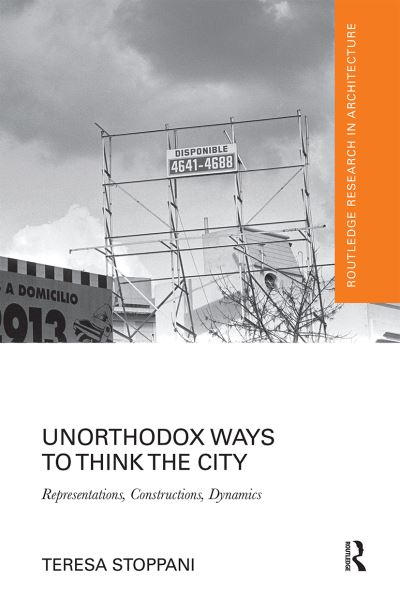
This book argues that architecture and the city and their processes can be better understood by drawing categories from disciplines that exceed the architectural and urban cultural context. It performs an open intellectual reading that traverses architecture and architectural theory, but also art theory and history, cartography, philosophy, literature and cultural studies, to unfold a series of 'figures' that are ambiguously placed between the representation and the construction of space in architecture and the city.
The paradigm and philosophy, the island and the city, the map and representation, the model and making and the questioning of form performed by dust, are explored beyond their definition, as processes that differently make space between architecture and the city and are proposed as unorthodox analytic techniques to decipher contemporary spatial complexity.
The book analyses how these 'figures' have been employed at different times and in different creative disciplines, beyond architecture and in relation to changing notions of space, and traces the role that they have played in the shift towards the dynamic that has taken place in contemporary theory and design research. What emerges is the idea of an 'architecture of the city' that is not only physical but is largely defined by the way in which its physical spaces are regulated, lived and perceived, but also imagined and projected.
| ISBN: | 9780367664084 |
| Publication date: | 30th September 2020 |
| Author: | Teresa Stoppani |
| Publisher: | Routledge an imprint of Taylor & Francis |
| Format: | Paperback |
| Pagination: | 194 pages |
| Series: | Routledge Research in Architecture |
| Genres: |
Theory of architecture Landscape architecture and design History of architecture Urban and municipal planning and policy Civil engineering, surveying and building |
This book argues that architecture and the city and their processes can be better understood by drawing categories from disciplines that exceed the architectural and urban cultural context. It performs an open intellectual reading that traverses architecture and architectural theory, but also art theory and history, cartography, philosophy, literature and cultural studies, to unfold a series of 'figures' that are ambiguously placed between the representation and the construction of space in architecture and the city.
The paradigm and philosophy, the island and the city, the map and representation, the model and making and the questioning of form performed by dust, are explored beyond their definition, as processes that differently make space between architecture and the city and are proposed as unorthodox analytic techniques to decipher contemporary spatial complexity.
The book analyses how these 'figures' have been employed at different times and in different creative disciplines, beyond architecture and in relation to changing notions of space, and traces the role that they have played in the shift towards the dynamic that has taken place in contemporary theory and design research. What emerges is the idea of an 'architecture of the city' that is not only physical but is largely defined by the way in which its physical spaces are regulated, lived and perceived, but also imagined and projected.
Unorthodox Ways to Think the City features in the following genres: Theory of architecture, Landscape architecture and design, History of architecture, Urban and municipal planning and policy, Civil engineering, surveying and building
Unorthodox Ways to Think the City is available in Paperback, Hardback, Ebook
Unorthodox Ways to Think the City was written by Teresa Stoppani and published by Routledge an imprint of Taylor & Francis
Unorthodox Ways to Think the City has 194 pages
Yes it is part of Routledge Research in Architecture series
£40.49