

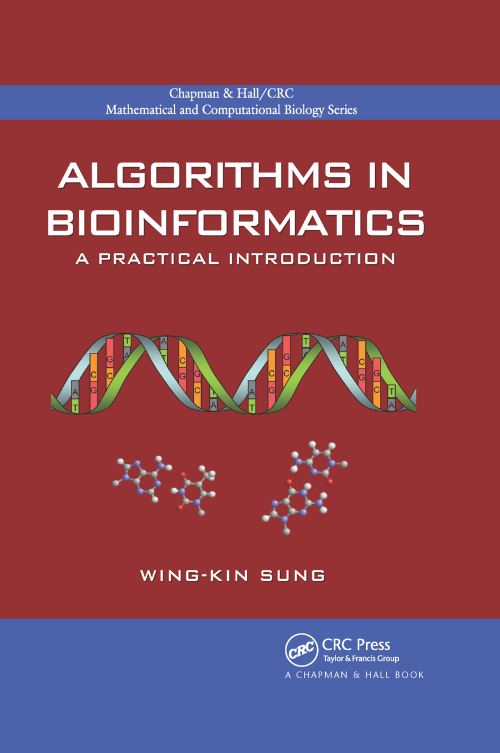
Thoroughly Describes Biological Applications, Computational Problems, and Various Algorithmic Solutions
Developed from the author's own teaching material, Algorithms in Bioinformatics: A Practical Introduction provides an in-depth introduction to the algorithmic techniques applied in bioinformatics. For each topic, the author clearly details the biological motivation and precisely defines the corresponding computational problems.
He also includes detailed examples to illustrate each algorithm and end-of-chapter exercises for students to familiarize themselves with the topics. Supplementary material is available at http://www.comp.nus.edu.sg/~ksung/algo_in_bioinfo/
This classroom-tested textbook begins with basic molecular biology concepts. It then describes ways to measure sequence similarity, presents simple applications of the suffix tree, and discusses the problem of searching sequence databases. After introducing methods for aligning multiple biological sequences and genomes, the text explores applications of the phylogenetic tree, methods for comparing phylogenetic trees, the problem of genome rearrangement, and the problem of motif finding.
It also covers methods for predicting the secondary structure of RNA and for reconstructing the peptide sequence using mass spectrometry. The final chapter examines the computational problem related to population genetics.
| ISBN: | 9780367659318 |
| Publication date: | 30th September 2020 |
| Author: | WingKin Sung |
| Publisher: | Chapman & Hall/CRC an imprint of CRC Press |
| Format: | Paperback |
| Pagination: | 408 pages |
| Series: | Chapman & Hall/CRC Mathematical and Computational Biology Series |
| Genres: |
Biology, life sciences Applied mathematics |
Thoroughly Describes Biological Applications, Computational Problems, and Various Algorithmic Solutions Developed from the author's own teaching material, Algorithms in Bioinformatics: A Practical Introduction provides an in-depth introduction to the algorithmic techniques applied in bioinformatics. For each topic, the author clearly details the biological motivation and precisely defines the corresponding computational problems.
Algorithms in Bioinformatics features in the following genres: Biology, life sciences, Applied mathematics
Hardback, Paperback, Ebook. £48.59, down from the £53.99 cover price. Not Available.
Algorithms in Bioinformatics was written by WingKin Sung and published by Chapman & Hall/CRC an imprint of CRC Press
Algorithms in Bioinformatics has 408 pages
Yes it is part of Chapman & Hall/CRC Mathematical and Computational Biology Series series
£48.59, reduced from £53.99. Not Available.