

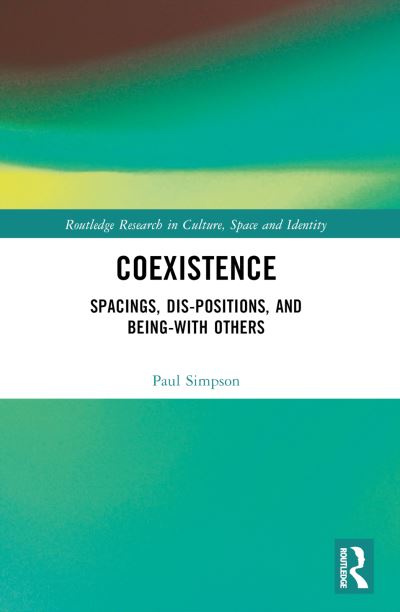
This book aims to develop an account of living together with difference which recognises the tension that we are inescapably with others - both human and non-human - but at the same time are always differing from and with those with whom we find ourselves.
A concern for coexistence and questions over how we might live together have been raised and approached from a host of conceptual starting points in recent times, including via calls for a rethinking of communism today, the articulation of forms of 'cosmopolitics' or 'pluralism', the re-figuring of understandings of ecology as dark or feminist, amongst others.
This book responds to such questions of coexistence by developing what it calls a 'co-existential analytic'. In doing so, this book introduces a range of post-phenomenological thought which offers means for thinking about such questions of living together with difference. The thought of Emanuel Levinas on the face of the other, Jean-Luc Nancy on being as being-with, Roberto Esposito on the munis, and Michel Henry on pathic auto-affection are introduced and critically reflected upon in terms of what they offer for thinking about such coexistence.
Alongside these conceptual starting points, a series of encounters - with cinema, everyday life, politics, and literature - are used to animate and illustration the discussion. Ultimately, the book argues for a 'spacing' of subjectivities with that world and those encountered within it.
This book is intended primarily for researchers and postgraduate students interested in questions of identity, difference, and subjectivity. It will be of interest to those in the fields of social and cultural geography, sociology, social theory, and cultural studies.
| ISBN: | 9780367558826 |
| Publication date: | 21st May 2026 |
| Author: | Paul Simpson |
| Publisher: | Routledge an imprint of Taylor & Francis |
| Format: | Paperback |
| Pagination: | 166 pages |
| Series: | Routledge Research in Culture, Space and Identity |
| Genres: |
Human geography Social and cultural anthropology Cultural studies Sociology |
This book aims to develop an account of living together with difference which recognises the tension that we are inescapably with others - both human and non-human - but at the same time are always differing from and with those with whom we find ourselves.A concern for coexistence and questions over how we might live together have been raised and approached from a host of conceptual starting points in recent times, including via calls for a rethinking of communism today, the articulation of forms of 'cosmopolitics' or 'pluralism', the re-figuring of understandings of ecology as dark or feminist, amongst others. This book responds to such questions of coexistence by developing what it calls a 'co-existential analytic'.
Coexistence features in the following genres: Human geography, Social and cultural anthropology, Cultural studies, Sociology
Paperback, Hardback. £43.19, down from the £47.99 cover price. Not Available.
Coexistence was written by Paul Simpson and published by Routledge an imprint of Taylor & Francis
Coexistence has 166 pages
Yes it is part of Routledge Research in Culture, Space and Identity series
£43.19, reduced from £47.99. Not Available.