

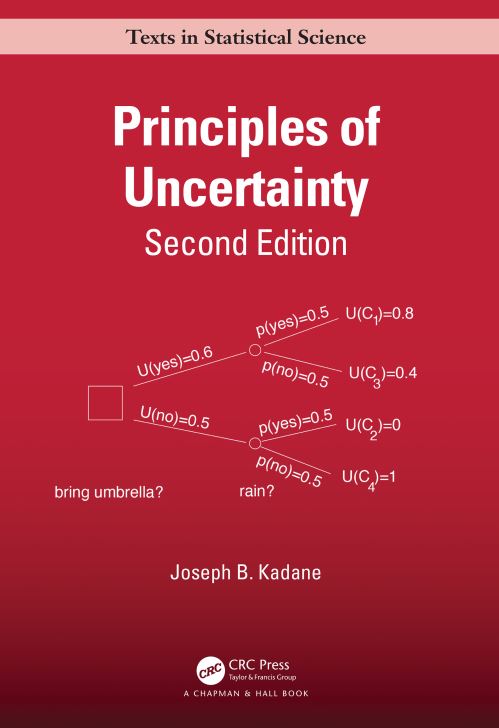
Praise for the first edition:
Principles of Uncertainty
It's a lovely book, one that I hope will be widely adopted as a course textbook.
-Michael Jordan, University of California, Berkeley, USA
Like the prize-winning first edition, Principles of Uncertainty, Second Edition is an accessible, comprehensive text on the theory of Bayesian Statistics written in an appealing, inviting style, and packed with interesting examples. It presents an introduction to the subjective Bayesian approach which has played a pivotal role in game theory, economics, and the recent boom in Markov Chain Monte Carlo methods. This new edition has been updated throughout and features new material on Nonparametric Bayesian Methods, the Dirichlet distribution, a simple proof of the central limit theorem, and new problems.
Key Features:
| ISBN: | 9780367539733 |
| Publication date: | 27th May 2024 |
| Author: | Joseph B Kadane |
| Publisher: | Chapman & Hall/CRC an imprint of CRC Press |
| Format: | Paperback |
| Pagination: | 498 pages |
| Series: | Chapman & Hall/CRC Texts in Statistical Science Series |
| Genres: |
Bayesian inference Decision theory: general |
Praise for the first edition: Principles of Uncertainty is a profound and mesmerising book on the foundations and principles of subjectivist or behaviouristic Bayesian analysis. … the book is a pleasure to read. And highly recommended for teaching as it can be used at many different levels. … A must-read for sure!-Christian Robert, CHANCEIt's a lovely book, one that I hope will be widely adopted as a course textbook.-Michael Jordan, University of California, Berkeley, USALike the prize-winning first edition, Principles of Uncertainty, Second Edition is an accessible, comprehensive text on the theory of Bayesian Statistics written in an appealing, inviting style, and packed with interesting examples.
Principles of Uncertainty features in the following genres: Bayesian inference, Decision theory: general
Paperback, Ebook. £44.99, down from the £49.99 cover price. Not Available.
Principles of Uncertainty was written by Joseph B Kadane and published by Chapman & Hall/CRC an imprint of CRC Press
Principles of Uncertainty has 498 pages
Yes it is part of Chapman & Hall/CRC Texts in Statistical Science Series series
£44.99, reduced from £49.99. Not Available.