

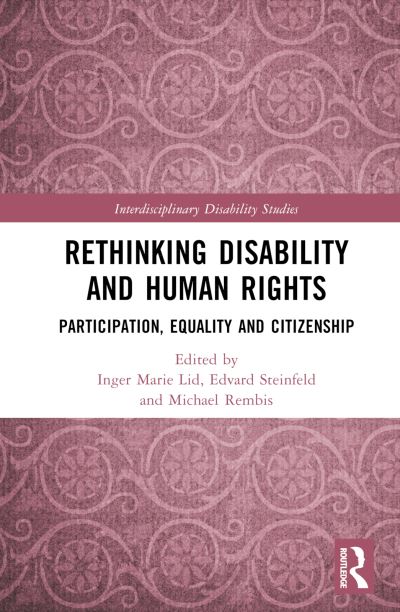
This book examines the role of disability in the right to political and social participation, an act of citizenship that many disabled people do not enjoy.
The disability rights movement does not accept the use of disability to create limits on citizenship, which poses challenges for contemporary societies that will become ever greater as the science and technology of enhancing human abilities evolves. Comprised of eight chapters, three interludes, and a postscript written by leading scholars and disability rights activists, the book explores citizenship for people with disabilities from an interdisciplinary perspective using the United Nations Convention on the Rights of Persons with Disabilities (CRPD) as a point of departure and the concept of universal design as a strategy for actualizing full citizenship for all. Situating disability in its historical and cultural contexts, the authors offer directions for rethinking citizenship, including implications for access to the built environment, information and communication systems, education, work, community life and politics.
This book will be of interest to all scholars and students working in disability studies, planning, architecture, public health, rehabilitation, social work, and education.
| ISBN: | 9780367511746 |
| Publication date: | 23rd June 2023 |
| Author: | Inger Marie Lid, Edward Steinfeld, Michael A Rembis |
| Publisher: | Routledge an imprint of Taylor & Francis |
| Format: | Hardback |
| Pagination: | 208 pages |
| Series: | Interdisciplinary Disability Studies |
| Genres: |
Personal and public health / health education Public international law: human rights Disability: social aspects Sociology |
This book examines the role of disability in the right to political and social participation, an act of citizenship that many disabled people do not enjoy.The disability rights movement does not accept the use of disability to create limits on citizenship, which poses challenges for contemporary societies that will become ever greater as the science and technology of enhancing human abilities evolves. Comprised of eight chapters, three interludes, and a postscript written by leading scholars and disability rights activists, the book explores citizenship for people with disabilities from an interdisciplinary perspective using the United Nations Convention on the Rights of Persons with Disabilities (CRPD) as a point of departure and the concept of universal design as a strategy for actualizing full citizenship for all.
Rethinking Disability and Human Rights features in the following genres: Personal and public health / health education, Public international law: human rights, Disability: social aspects, Sociology
Hardback. £154.79, down from the £171.99 cover price. Not Available.
Rethinking Disability and Human Rights was written by Inger Marie Lid, Edward Steinfeld, Michael A Rembis and published by Routledge an imprint of Taylor & Francis
Rethinking Disability and Human Rights has 208 pages
Yes it is part of Interdisciplinary Disability Studies series
£154.79, reduced from £171.99. Not Available.