

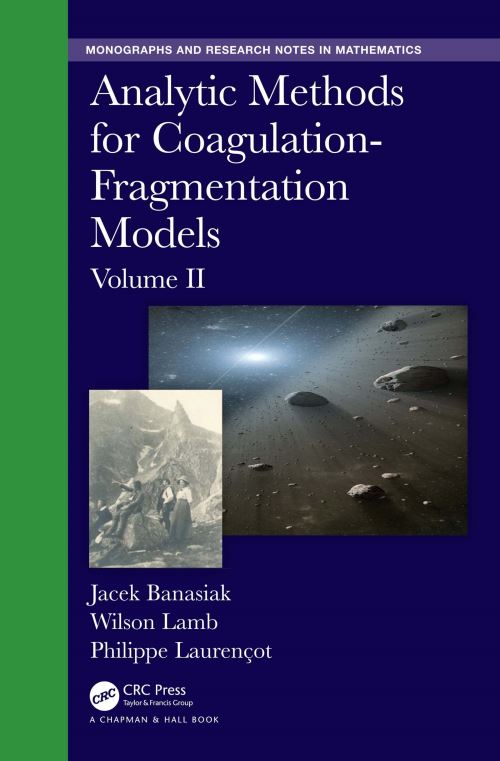
Analytic Methods for Coagulation-Fragmentation Models is a two-volume set that provides a comprehensive exposition of the mathematical analysis of coagulation-fragmentation models. Initially, an in-depth survey of coagulation-fragmentation processes is presented, together with an account of relevant early results obtained on the associated model equations. These provide motivation for the subsequent detailed treatment of more up-to-date investigations which have led to significant theoretical developments on topics such as solvability and the long-term behaviour of solutions. To make the account as self-contained as possible, the mathematical tools that feature prominently in these modern treatments are introduced at appropriate places. The main theme of Volume I is the analysis of linear fragmentation models, with Volume II devoted to processes that involve the nonlinear contribution of coagulation.
Features of Volume II:
| ISBN: | 9780367235482 |
| Publication date: | 11th September 2019 |
| Author: | J Banasiak, Wilson Lamb, Philippe Laurençot |
| Publisher: | CRC Press |
| Format: | Hardback |
| Pagination: | 322 pages |
| Series: | Chapman & Hall/CRC Monographs and Research Notes in Mathematics |
| Genres: |
Functional analysis and transforms Differential calculus and equations |
Analytic Methods for Coagulation-Fragmentation Models is a two-volume set that provides a comprehensive exposition of the mathematical analysis of coagulation-fragmentation models. Initially, an in-depth survey of coagulation-fragmentation processes is presented, together with an account of relevant early results obtained on the associated model equations.
Analytic Methods for Coagulation-Fragmentation Models. Volume II features in the following genres: Functional analysis and transforms, Differential calculus and equations
Hardback. £169.19, down from the £187.99 cover price. Not Available.
Analytic Methods for Coagulation-Fragmentation Models. Volume II was written by J Banasiak, Wilson Lamb, Philippe Laurençot and published by CRC Press
Analytic Methods for Coagulation-Fragmentation Models. Volume II has 322 pages
Yes it is part of Chapman & Hall/CRC Monographs and Research Notes in Mathematics series
£169.19, reduced from £187.99. Not Available.