

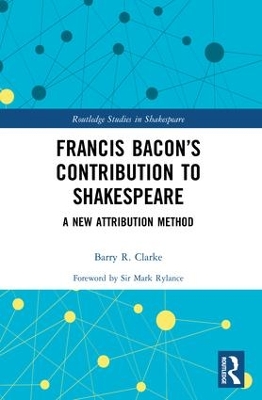
Francis Bacon's Contribution to Shakespeare advocates a paradigm shift away from a single-author theory of the Shakespeare work towards a many-hands theory. Here, the middle ground is adopted between competing so-called Stratfordian and alternative single-author conspiracy theories. In the process, arguments are advanced as to why Shakespeare’s First Folio (1623) presents as an unreliable document for attribution, and why contemporary opinion characterised Shakspere [his baptised name] as an opportunist businessman who acquired the work of others.
Current methods of authorship attribution are critiqued, and an entirely new Rare Collocation Profiling (RCP) method is introduced which, unlike current stylometric methods, is capable of detecting multiple contributors to a text. Using the Early English Books Online database, rare phrases and collocations in a target text are identified together with the authors who used them. This allows a DNA-type profile to be constructed for the possible contributors to a text that also takes into account direction of influence.
The method brings powerful new evidence to bear on crucial questions such as the author of the Groats-worth of Witte (1592) letter, the identifiable hands in 3 Henry VI, the extent of Francis Bacon’s contribution to Twelfth Night and The Tempest, and the scheduling of Love’s Labour’s Lost at the 1594–5 Gray’s Inn Christmas revels for which Bacon wrote entertainments. The treatise also provides detailed analyses of the nature of the complaint against Shakspere in the Groats-worth letter, the identity of the players who performed The Comedy of Errors at Gray’s Inn in 1594, and the reasons why Shakspere could not have had access to Virginia colony information that appears in The Tempest.
With a Foreword by Sir Mark Rylance, this meticulously researched and penetrating study is a thought-provoking read for the inquisitive student in Shakespeare Studies.
| ISBN: | 9780367225445 |
| Publication date: | 6th February 2019 |
| Author: | Barry R Clarke, Mark Rylance |
| Publisher: | Routledge an imprint of Taylor & Francis Ltd |
| Format: | Paperback |
| Pagination: | 310 pages |
| Series: | Routledge Studies in Shakespeare |
| Genres: |
Literary studies: plays and playwrights Literary studies: general Literary theory |
Francis Bacon's Contribution to Shakespeare advocates a paradigm shift away from a single-author theory of the Shakespeare work towards a many-hands theory. Here, the middle ground is adopted between competing so-called Stratfordian and alternative single-author conspiracy theories.
Francis Bacon’s Contribution to Shakespeare features in the following genres: Literary studies: plays and playwrights, Literary studies: general, Literary theory
Paperback, Hardback. £43.19, down from the £47.99 cover price. Not Available.
Francis Bacon’s Contribution to Shakespeare was written by Barry R Clarke, Mark Rylance and published by Routledge an imprint of Taylor & Francis Ltd
Francis Bacon’s Contribution to Shakespeare has 310 pages
Yes it is part of Routledge Studies in Shakespeare series
£43.19, reduced from £47.99. Not Available.