

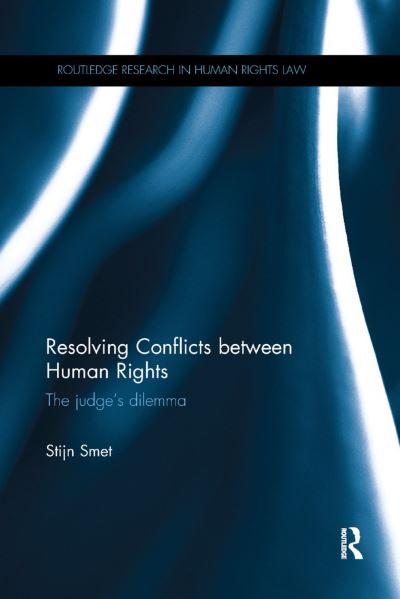
Under the influence of the global spread of human rights, legal disputes are increasingly framed in human rights terms. Parties to a legal dispute can often invoke human rights norms in support of their competing claims. Yet, when confronted with cases in which human rights conflict, judges face a dilemma. They have to make difficult choices between superior norms that deserve equal respect. In this high-level book, the author sets out how judges the world over could resolve conflicts between human rights. He presents an innovative legal theoretical account of such conflicts, questioning the relevance of the influential proportionality test to their resolution. Instead, the author develops a novel resolution framework, specifically designed to tackle human rights conflicts. The book combines concerted normative theory with profound practical analysis, firmly rooting its theoretical arguments in human rights practice. Although the analysis draws primarily on the case law of the European Court of Human Rights, the book's core arguments are applicable to judicial practice in general. As such, the book should be of great interest to academics, postgraduate students and legal practitioners in Europe and beyond. The book is particularly suited for use in advanced courses on legal theory, human rights law and jurisprudence.
| ISBN: | 9780367075668 |
| Publication date: | 18th October 2018 |
| Author: | Stijn Smet |
| Publisher: | Routledge an imprint of Taylor & Francis |
| Format: | Paperback |
| Pagination: | 244 pages |
| Series: | Routledge Research in Human Rights Law |
| Genres: |
Public international law: human rights Social and political philosophy Human rights, civil rights Jurisprudence and general issues |
Under the influence of the global spread of human rights, legal disputes are increasingly framed in human rights terms. Parties to a legal dispute can often invoke human rights norms in support of their competing claims.
Resolving Conflicts Between Human Rights features in the following genres: Public international law: human rights, Social and political philosophy, Human rights, civil rights, Jurisprudence and general issues
Paperback, Hardback, Ebook. £45.89, down from the £50.99 cover price. Not Available.
Resolving Conflicts Between Human Rights was written by Stijn Smet and published by Routledge an imprint of Taylor & Francis
Resolving Conflicts Between Human Rights has 244 pages
Yes it is part of Routledge Research in Human Rights Law series
£45.89, reduced from £50.99. Not Available.