

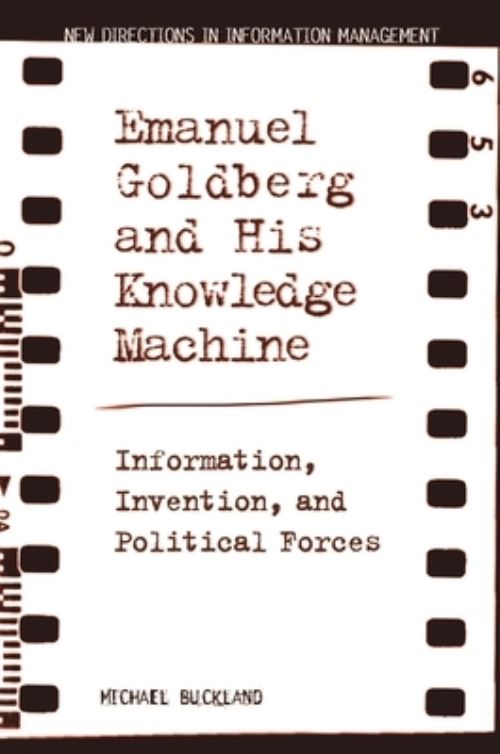
This book tells the story of Emanuel Goldberg, a chemist, inventor, and industrialist who contributed to almost every aspect of imaging technology in the first half of the 20th century. Despite his accomplishments, history has not been kind to Goldberg, a name all but erased from the annals of information science. An incredible story emerges as Michael Buckland unearths forgotten documents and rogue citations to show that, contrary to public opinion, Goldberg created the first desktop search engine, developed microdot technology, and designed the famous Contax 35 mm camera. A fascinating and illuminating tribute to a great mind and a crucial period in the history of information science and technology.
An incredible story emerges as Buckland unearths forgotten documents and rogue citations to make the case that it was Goldberg, not Vannevar Bush, who created the first desktop search engine. Goldberg, not Professor Zapp (a figment of J. Edgar Hoover's imagination), who developed microdot technology.
Goldberg, not Heinz Kueppenbender, who designed the famous Contax 35 mm camera. Buckland firmly yet engagingly gives credit where credit is due, in the process shedding light on the circumstances that led to Goldberg's obscurity. The result is an illuminating tribute to a great mind, and a fascinating investigation of a crucial period in the history of information science and technology.
| ISBN: | 9780313313325 |
| Publication date: | 31st March 2006 |
| Author: | Michael K Buckland |
| Publisher: | Libraries Unlimited an imprint of ABC-CLIO |
| Format: | Paperback |
| Pagination: | 380 pages |
| Series: | New Directions in Information Management |
| Genres: |
Computer science |
This book tells the story of Emanuel Goldberg, a chemist, inventor, and industrialist who contributed to almost every aspect of imaging technology in the first half of the 20th century. Despite his accomplishments, history has not been kind to Goldberg, a name all but erased from the annals of information science.
Emanuel Goldberg and His Knowledge Machine features in the following genres: Computer science
Paperback. Not Available.
Emanuel Goldberg and His Knowledge Machine was written by Michael K Buckland and published by Libraries Unlimited an imprint of ABC-CLIO
Emanuel Goldberg and His Knowledge Machine has 380 pages
Yes it is part of New Directions in Information Management series