

The main characteristics of the real-world decision-making problems facing humans today are multidimensional and have multiple objectives including eco- nomic, environmental, social, and technical ones. Hence, it seems natural that the consideration of many objectives in the actual decision-making process re- quires multiobjective approaches rather than single-objective. One ofthe major systems-analytic multiobjective approaches to decision-making under constraints is multiobjective optimization as a generalization of traditional single-objective optimization.
Although multiobjective optimization problems differ from single- objective optimization problems only in the plurality of objective functions, it is significant to realize that multiple objectives are often noncom mensurable and conflict with each other in multiobjective optimization problems. With this ob- servation, in multiobjective optimization, the notion of Pareto optimality or effi- ciency has been introduced instead of the optimality concept for single-objective optimization.
However, decisions with Pareto optimality or efficiency are not uniquely determined; the final decision must be selected from among the set of Pareto optimal or efficient solutions. Therefore, the question is, how does one find the preferred point as a compromise or satisficing solution with rational pro- cedure? This is the starting point of multiobjective optimization.
To be more specific, the aim is to determine how one derives a compromise or satisficing so- lution of a decision maker (DM), which well represents the subjective judgments, from a Pareto optimal or an efficient solution set.
| ISBN: | 9780306443374 |
| Publication date: | 28th February 1993 |
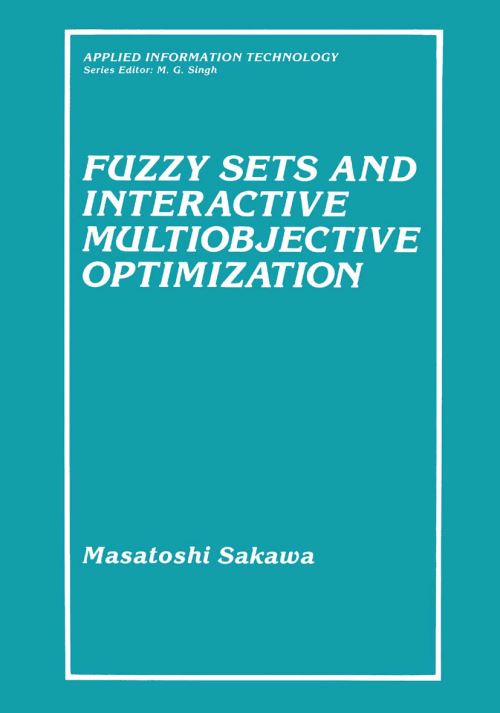
| Author: | Masatoshi Sakawa |
| Publisher: | Springer an imprint of Springer US |
| Format: | Hardback |
| Pagination: | 308 pages |
| Series: | Applied Information Technology |
| Genres: |
Mathematics Computer science |
The main characteristics of the real-world decision-making problems facing humans today are multidimensional and have multiple objectives including eco- nomic, environmental, social, and technical ones. Hence, it seems natural that the consideration of many objectives in the actual decision-making process re- quires multiobjective approaches rather than single-objective.
Fuzzy Sets and Interactive Multiobjective Optimization features in the following genres: Mathematics, Computer science
Ebook, Hardback. Not Available.
Fuzzy Sets and Interactive Multiobjective Optimization was written by Masatoshi Sakawa and published by Springer an imprint of Springer US
Fuzzy Sets and Interactive Multiobjective Optimization has 308 pages
Yes it is part of Applied Information Technology series