

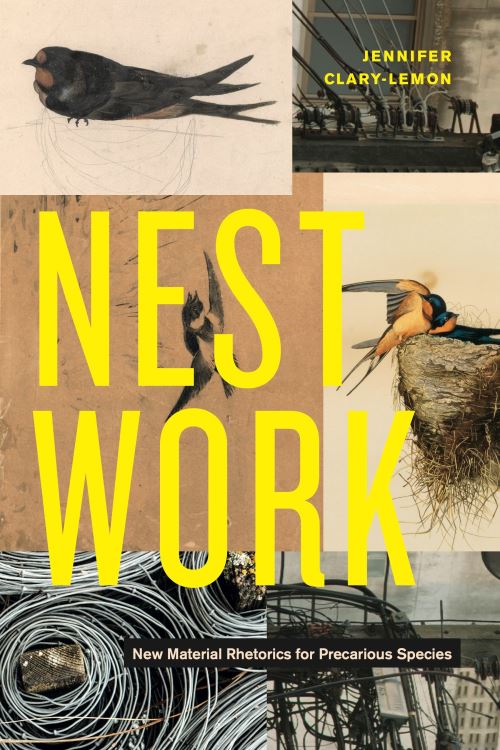
As more and more species fall under the threat of extinction, humans are not only taking action to protect critical habitats but are also engaging more directly with species to help mitigate their decline. Through innovative infrastructure design and by changing how we live, humans are becoming more attuned to nonhuman animals and are making efforts to live alongside them.
Examining sites of loss, temporal orientations, and infrastructural mitigations, Nestwork blends rhetorical and posthuman sensibilities in service of the ecological care. In this innovative ethnographic study, rhetorician Jennifer Clary-Lemon examines human-nonhuman animal interactions, identifying forms of communication between species and within their material world.
Looking in particular at nonhuman species that depend on human development for their habitat, Clary-Lemon examines the cases of the barn swallow, chimney swift, and bobolink. She studies their habitats along with the unique mitigation efforts taken by humans to maintain those habitats, including building "barn swallow gazebos" and artificial chimneys and altering farming practices to allow for nesting and breeding.
What she reveals are fascinating forms of rhetoric not expressed through language but circulating between species and materials objects.
Nestwork explores what are in essence nonlinguistic and decidedly nonhuman arguments within these local environments. Drawing on new materialist and Indigenous ontologies, the book helps attune our senses to the tragedy of species decline and to a new understanding of home and homemaking.
| ISBN: | 9780271095448 |
| Publication date: | 13th September 2024 |
| Author: | Jennifer ClaryLemon |
| Publisher: | Penn State University Press an imprint of Penn State University Libraries |
| Format: | Paperback |
| Pagination: | 190 pages |
| Series: | The RSA Series in Transdisciplinary Rhetoric |
| Genres: |
Semantics, discourse analysis, stylistics |
As more and more species fall under the threat of extinction, humans are not only taking action to protect critical habitats but are also engaging more directly with species to help mitigate their decline. Through innovative infrastructure design and by changing how we live, humans are becoming more attuned to nonhuman animals and are making efforts to live alongside them.Examining sites of loss, temporal orientations, and infrastructural mitigations, Nestwork blends rhetorical and posthuman sensibilities in service of the ecological care.
Nestwork features in the following genres: Semantics, discourse analysis, stylistics
Paperback, Hardback. Not Available.
Nestwork was written by Jennifer ClaryLemon and published by Penn State University Press an imprint of Penn State University Libraries
Nestwork has 190 pages
Yes it is part of The RSA Series in Transdisciplinary Rhetoric series