

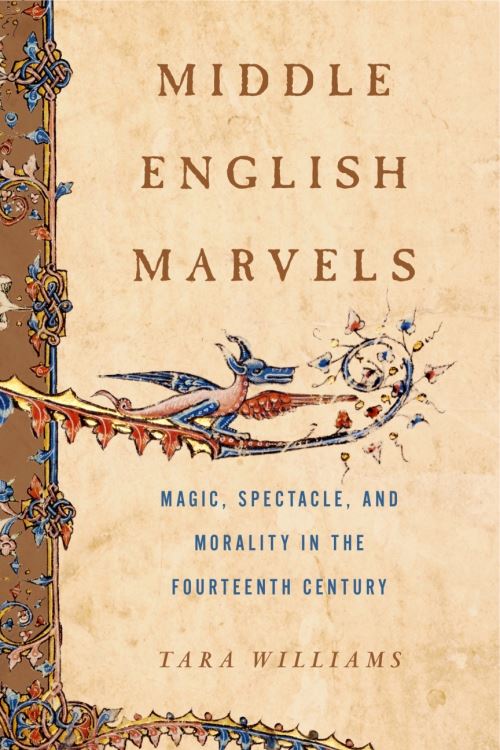
This multidisciplinary volume illustrates how representations of magic in fourteenth-century romances link the supernatural, spectacle, and morality in distinctive ways.Supernatural marvels represented in vivid visual detail are foundational to the characteristic Middle English genres of romance and hagiography. In Middle English Marvels, Tara Williams explores the didactic and affective potential of secular representations of magic and shows how fourteenth-century English writers tested the limits of that potential.
Drawing on works by Augustine, Gervase of Tilbury, Chaucer, and the anonymous poets of Sir Orfeo and Sir Gawain and the Green Knight, among others, Williams examines how such marvels might convey moral messages within and beyond the narrative. She analyzes examples from both highly canonical and more esoteric texts and examines marvels that involve magic and transformation, invoke visual spectacle, and invite moral reflection on how one should relate to others.
Within this shared framework, Williams finds distinct concerns—chivalry, identity, agency, and language—that intersect with the marvelous in significant ways.Integrating literary and historical approaches to the study of magic, this volume convincingly shows how certain fourteenth-century texts eschewed the predominant trends and developed a new theory of the marvelous. Williams's engaging, erudite study will be of special interest to scholars of the occult, the medieval and early modern eras, and literature.
| ISBN: | 9780271079646 |
| Publication date: | 12th July 2019 |
| Author: | Tara Williams |
| Publisher: | Penn State University Press |
| Format: | Paperback |
| Pagination: | 184 pages |
| Genres: |
Literary studies: ancient, classical and medieval |
This multidisciplinary volume illustrates how representations of magic in fourteenth-century romances link the supernatural, spectacle, and morality in distinctive ways.Supernatural marvels represented in vivid visual detail are foundational to the characteristic Middle English genres of romance and hagiography. In Middle English Marvels, Tara Williams explores the didactic and affective potential of secular representations of magic and shows how fourteenth-century English writers tested the limits of that potential.
Middle English Marvels features in the following genres: Literary studies: ancient, classical and medieval
Paperback, Hardback. Not Available.
Middle English Marvels was written by Tara Williams and published by Penn State University Press
Middle English Marvels has 184 pages