

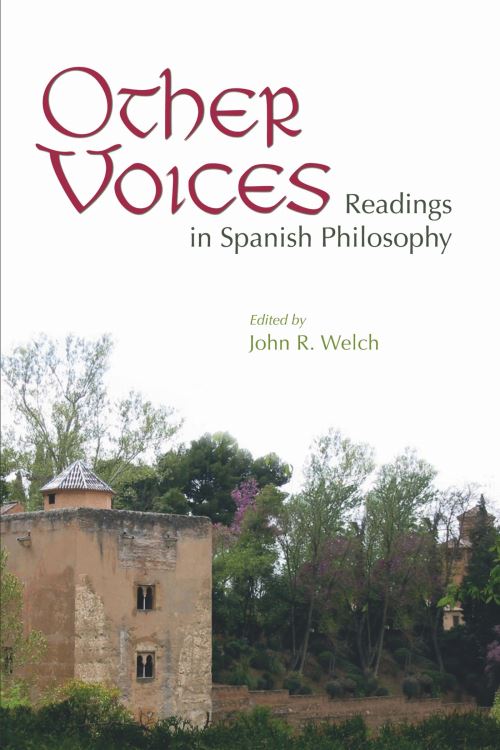
English-speaking philosophers are generally attuned to the German and French philosophical traditions but not to the Spanish. Why, for example, does someone with the vivid appeal of Bartolomé de Las Casas remain almost completely unknown in North America? The purpose of this anthology is to introduce the Spanish philosophical tradition to English-speaking readers.
Other Voices: Readings in Spanish Philosophy represents high points of nearly two millennia of Spanish philosophy, from first-century thinkers in Roman Hispania to those of the twentieth century. John R. Welch has selected, and in several cases translated excerpts from the works of thirteen philosophers: Seneca, Quintilian, Isidore of Seville, Ibn Rushd (Averroës), Moses Maimonides, Ramón Llull, Juan Luis Vives, Francisco de Vitoria, Bartolomé de Las Casas, Francisco Suárez, Benito Jerónimo Feijóo, Miguel de Unamuno, and José Ortega y Gasset.
Welch provides for the reader a brief introduction to each historical period or philosophical movement represented and a biographical introduction to each philosopher. Of special interest are the selection from Feijóo's "A Defense of Women" (an attack on misogyny), which has not been translated into English since the eighteenth century; the arguments on the justification of war by Vitoria and Las Casas (in the context of the Spanish conquest); and Unamuno's celebration of the concrete over the abstract, desire over reason.
| ISBN: | 9780268044190 |
| Publication date: | 31st May 2010 |
| Author: | John R Welch |
| Publisher: | University of Notre Dame Press |
| Format: | Paperback |
| Pagination: | 363 pages |
| Genres: |
Historical and comparative linguistics Philosophical traditions and schools of thought Literature: history and criticism |
English-speaking philosophers are generally attuned to the German and French philosophical traditions but not to the Spanish. Why, for example, does someone with the vivid appeal of Bartolomé de Las Casas remain almost completely unknown in North America?
Other Voices features in the following genres: Historical and comparative linguistics, Philosophical traditions and schools of thought, Literature: history and criticism
Paperback. Not Available.
Other Voices was written by John R Welch and published by University of Notre Dame Press
Other Voices has 363 pages