

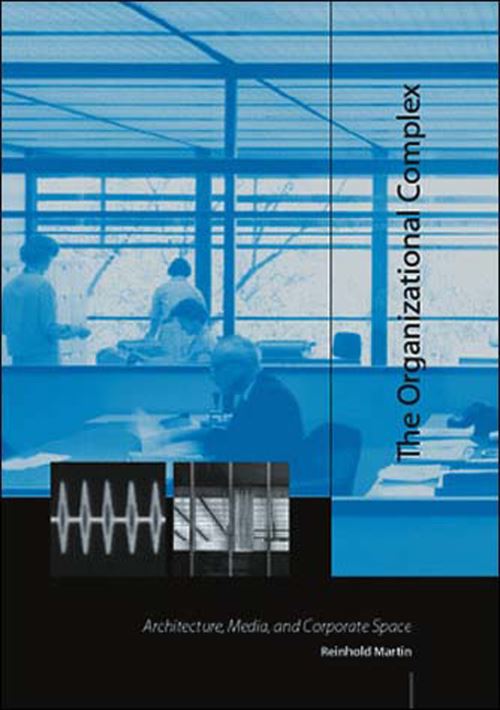
A historical and theoretical analysis of corporate architecture in the United States after the Second World War.
The Organizational Complex is a historical and theoretical analysis of corporate architecture in the United States after the Second World War. Its title refers to the aesthetic and technological extension of the military-industrial complex, in which architecture, computers, and corporations formed a network of objects, images, and discourses that realigned social relations and transformed the postwar landscape.
In-depth case studies of architect Eero Saarinen's work for General Motors, IBM, and Bell Laboratories and analyses of office buildings designed by Skidmore, Owings & Merrill trace the emergence of a systems-based model of organization in architecture, in which the modular curtain wall acts as both an organizational device and a carrier of the corporate image. Such an image-of the corporation as a flexible, integrated system-is seen to correspond with a "humanization" of corporate life, as corporations decentralize both spatially and administratively.
Parallel analyses follow the assimilation of cybernetics into aesthetics in the writings of artist and visual theorist Gyorgy Kepes, as art merges with techno-science in the service of a dynamic new "pattern-seeing." Image and system thus converge in the organizational complex, while top-down power dissolves into networked, pattern-based control. Architecture, as one among many media technologies, supplies the patterns-images of organic integration designed to regulate new and unstable human-machine assemblages.
| ISBN: | 9780262633260 |
| Publication date: | 23rd September 2005 |
| Author: | Reinhold Martin |
| Publisher: | The MIT Press |
| Format: | Paperback |
| Pagination: | 324 pages |
| Series: | The MIT Press |
| Genres: |
Theory of architecture |
A historical and theoretical analysis of corporate architecture in the United States after the Second World War.The Organizational Complex is a historical and theoretical analysis of corporate architecture in the United States after the Second World War. Its title refers to the aesthetic and technological extension of the military-industrial complex, in which architecture, computers, and corporations formed a network of objects, images, and discourses that realigned social relations and transformed the postwar landscape.In-depth case studies of architect Eero Saarinen's work for General Motors, IBM, and Bell Laboratories and analyses of office buildings designed by Skidmore, Owings & Merrill trace the emergence of a systems-based model of organization in architecture, in which the modular curtain wall acts as both an organizational device and a carrier of the corporate image.
The Organizational Complex features in the following genres: Theory of architecture
Paperback. Not Available.
The Organizational Complex was written by Reinhold Martin and published by The MIT Press
The Organizational Complex has 324 pages
Yes it is part of The MIT Press series