

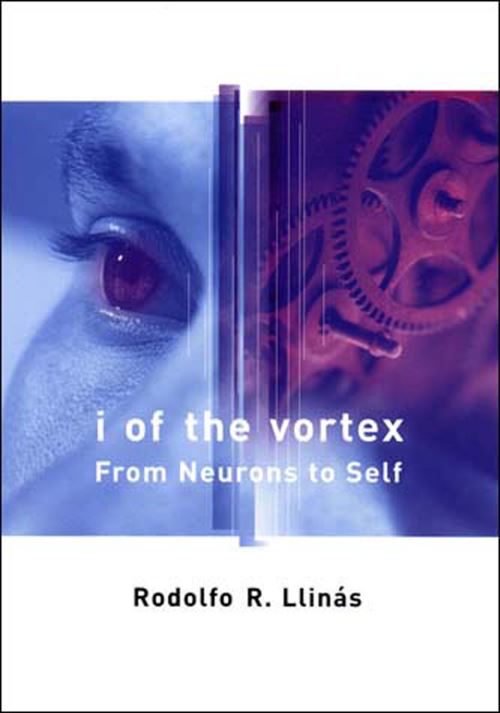
A highly original theory of how the mind-brain works, based on the author's study of single neuronal cells.
In I of the Vortex, Rodolfo Llinas, a founding father of modern brain science, presents an original view of the evolution and nature of mind. According to Llinas, the "mindness state" evolved to allow predictive interactions between mobile creatures and their environment. He illustrates the early evolution of mind through a primitive animal called the "sea squirt." The mobile larval form has a brainlike ganglion that receives sensory information about the surrounding environment.
As an adult, the sea squirt attaches itself to a stationary object and then digests most of its own brain. This suggests that the nervous system evolved to allow active movement in animals. To move through the environment safely, a creature must anticipate the outcome of each movement on the basis of incoming sensory data.
Thus the capacity to predict is most likely the ultimate brain function. One could even say that Self is the centralization of prediction.
At the heart of Llinas's theory is the concept of oscillation. Many neurons possess electrical activity, manifested as oscillating variations in the minute voltages across the cell membrane. On the crests of these oscillations occur larger electrical events that are the basis for neuron-to-neuron communication.
Like cicadas chirping in unison, a group of neurons oscillating in phase can resonate with a distant group of neurons. This simultaneity of neuronal activity is the neurobiological root of cognition. Although the internal state that we call the mind is guided by the senses, it is also generated by the oscillations within the brain.
Thus, in a certain sense, one could say that reality is not all "out there," but is a kind of virtual reality.
| ISBN: | 9780262621632 |
| Publication date: | 14th March 2002 |
| Author: | R Llinás |
| Publisher: | The MIT Press |
| Format: | Paperback |
| Pagination: | 302 pages |
| Series: | A Bradford Book |
| Genres: |
Neurology and clinical neurophysiology |
A highly original theory of how the mind-brain works, based on the author's study of single neuronal cells.In I of the Vortex, Rodolfo Llinas, a founding father of modern brain science, presents an original view of the evolution and nature of mind. According to Llinas, the "mindness state" evolved to allow predictive interactions between mobile creatures and their environment.
I of the Vortex features in the following genres: Neurology and clinical neurophysiology
Paperback. Not Available.
I of the Vortex was written by R Llinás and published by The MIT Press
I of the Vortex has 302 pages
Yes it is part of A Bradford Book series