

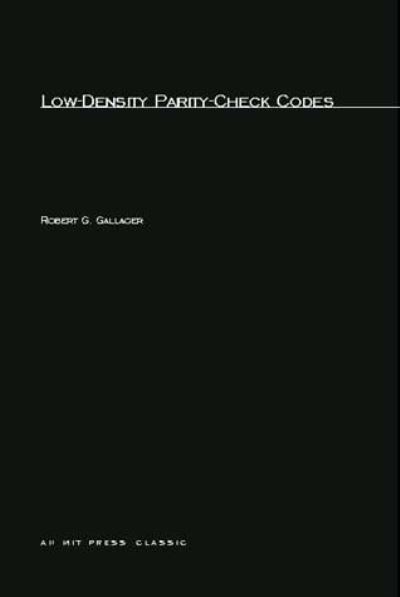
This is a complete presentation of all important theoretical and experimental work done on low-density codes. Low-density coding is one of the three techniques thus far developed for efficient communication over noisy channels with an arbitrarily low probability of error. A principal result of information theory is that if properly coded information is transmitted over a noisy channel at a rate below channel capacity, the probability of error can be made to approach zero exponentially with the code length. Any practical use of this theorem, however, requires a coding scheme in which the cost of storage and computation equipment grows slowly with code length. The present book analyzes a class of coding schemes for which costs grow approximately linearly with code length. It demonstrates that error probability approaches zero exponentially with a root of the block length and cites experimental evidence that this coding scheme has profitable aplicability in many communications situations.
| ISBN: | 9780262571777 |
| Publication date: | 17th March 2003 |
| Author: | Robert G Gallager |
| Publisher: | The MIT Press |
| Format: | Paperback |
| Pagination: | 116 pages |
| Series: | The MIT Press |
| Genres: |
Programming and scripting languages: general |
This is a complete presentation of all important theoretical and experimental work done on low-density codes. Low-density coding is one of the three techniques thus far developed for efficient communication over noisy channels with an arbitrarily low probability of error.
Low-Density Parity-Check Codes features in the following genres: Programming and scripting languages: general
Paperback. Not Available.
Low-Density Parity-Check Codes was written by Robert G Gallager and published by The MIT Press
Low-Density Parity-Check Codes has 116 pages
Yes it is part of The MIT Press series