

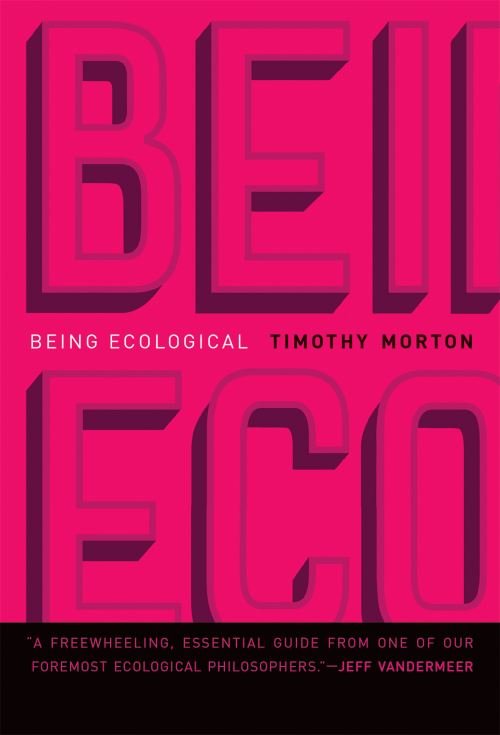
A book about ecology without information dumping, guilt inducing, or preaching to the choir.Don't care about ecology? You think you don't, but you might all the same. Don't read ecology books?
This book is for you. Ecology books can be confusing information dumps that are out of date by the time they hit you. Slapping you upside the head to make you feel bad.
Grabbing you by the lapels while yelling disturbing facts. Handwringing in agony about "What are we going to do?" This book has none of that. Being Ecological doesn't preach to the eco-choir.
It's for you—even, Timothy Morton explains, if you're not in the choir, even if you have no idea what choirs are. You might already be ecological.After establishing the approach of the book (no facts allowed!), Morton draws on Kant and Heidegger to help us understand living in an age of mass extinction caused by global warming. He considers the object of ecological awareness and ecological thinking: the biosphere and its interconnections.
He discusses what sorts of actions count as ecological—starting a revolution? going to the garden center to smell the plants? And finally, in "Not a Grand Tour of Ecological Thought," he explores a variety of current styles of being ecological—a range of overlapping orientations rather than preformatted self-labeling.
Caught up in the us-versus-them (or you-versus-everything else) urgency of ecological crisis, Morton suggests, it's easy to forget that you are a symbiotic being entangled with other symbiotic beings.
Isn't that being ecological?
| ISBN: | 9780262537124 |
| Publication date: | 9th July 2020 |
| Author: | Timothy Morton |
| Publisher: | The MIT Press |
| Format: | Paperback |
| Pagination: | 216 pages |
| Series: | The MIT Press |
| Genres: |
Environmental policy and protocols Popular philosophy Social impact of environmental issues |
A book about ecology without information dumping, guilt inducing, or preaching to the choir.Don't care about ecology? You think you don't, but you might all the same.
Being Ecological features in the following genres: Environmental policy and protocols, Popular philosophy, Social impact of environmental issues
Paperback, Ebook. Not Available.
Being Ecological was written by Timothy Morton and published by The MIT Press
Being Ecological has 216 pages
Yes it is part of The MIT Press series