

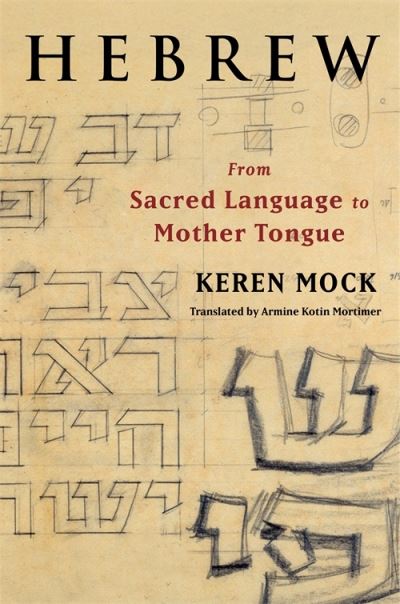
For nearly two thousand years, Hebrew belonged to the realm of the sacred. A written liturgical language used primarily by rabbis and scholars, it was not spoken in everyday contexts. A revival process in the late nineteenth century brought Hebrew back into daily use, adapting sacred texts as the foundations for a new vernacular. A "mother tongue" emerged.
Keren Mock provides a strikingly original multidisciplinary account of this transformation of Hebrew from an ancient sacred tongue to a secular spoken language. Bringing together psychoanalytic, semiotic, and comparative-literature perspectives, she provides deep insight into key moments in this history.
Drawing on extensive, revealing interviews, Mock offers critical readings of two major Israeli authors, Aharon Appelfeld and Sami Michael, focusing on their struggles to write in Hebrew as immigrants. She delves into the archives of the lexicographer Eliezer Ben-Yehuda, the creator of an all-embracing dictionary of ancient and modern Hebrew, and considers Baruch Spinoza's little-known Hebrew grammar in light of his philosophical works.
In reflecting on the making and meaning of a mother tongue, Mock addresses questions of memory and forgetting, mourning and restitution, and the sacred and the secular. Through the exceptional history of Hebrew, this book uncovers the workings of language in the social and psychological realms.
Hebrew features forewords by Pierre-Marc de Biasi, an artist and scholar of literature, and Julia Kristeva, a renowned psychoanalyst, philosopher, and linguist, speaking to the significance of the book.
| ISBN: | 9780231217118 |
| Publication date: | 23rd December 2025 |
| Author: | Keren Mock |
| Publisher: | Columbia University Press |
| Format: | Hardback |
| Pagination: | 360 pages |
| Series: | European Perspectives |
| Genres: |
Psycholinguistics and cognitive linguistics Historical and comparative linguistics |
For nearly two thousand years, Hebrew belonged to the realm of the sacred. A written liturgical language used primarily by rabbis and scholars, it was not spoken in everyday contexts.
Hebrew features in the following genres: Psycholinguistics and cognitive linguistics, Historical and comparative linguistics
Hardback, Paperback. Not Available.
Hebrew was written by Keren Mock and published by Columbia University Press
Hebrew has 360 pages
Yes it is part of European Perspectives series