

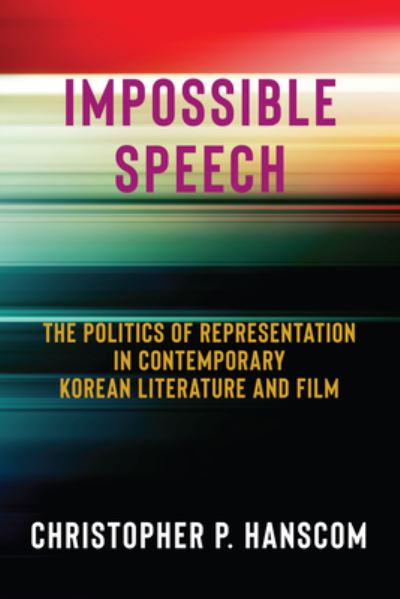
In what ways can or should art engage with its social context? Authors, readers, and critics have been preoccupied with this question since the dawn of modern literature in Korea. Advocates of social engagement have typically focused on realist texts, seeing such works as best suited to represent injustices and inequalities by describing them as if they were before our very eyes.
Christopher P. Hanscom questions this understanding of political art by examining four figures central to recent Korean fiction, film, and public discourse: the migrant laborer, the witness to or survivor of state violence, the refugee, and the socially excluded urban precariat. Instead of making these marginalized figures intelligible to common sense, this book reveals the capacity of art to address the "impossible speech" of those who are not asked, expected, or allowed to put forward their thoughts, yet who in so doing expand the limits of the possible.
Impossible Speech proposes a new approach to literature and film that foregrounds ostensibly "nonpolitical" or nonsensical moments, challenging assumptions about the relationship between politics and art that locate the "politics" of the work in the representation of content understood in advance as being political. Recasting the political as a struggle over the possibility or impossibility of speech itself, this book finds the politics of a work of art in its power to confront the boundaries of what is sayable.
| ISBN: | 9780231208482 |
| Publication date: | 26th March 2024 |
| Author: | Christopher P Hanscom |
| Publisher: | Columbia University Press |
| Format: | Hardback |
| Pagination: | 240 pages |
| Genres: |
Literary studies: fiction, novelists and prose writers Politics and government |
In what ways can or should art engage with its social context? Authors, readers, and critics have been preoccupied with this question since the dawn of modern literature in Korea.
Impossible Speech features in the following genres: Literary studies: fiction, novelists and prose writers, Politics and government
Paperback, Hardback. Not Available.
Impossible Speech was written by Christopher P Hanscom and published by Columbia University Press
Impossible Speech has 240 pages