

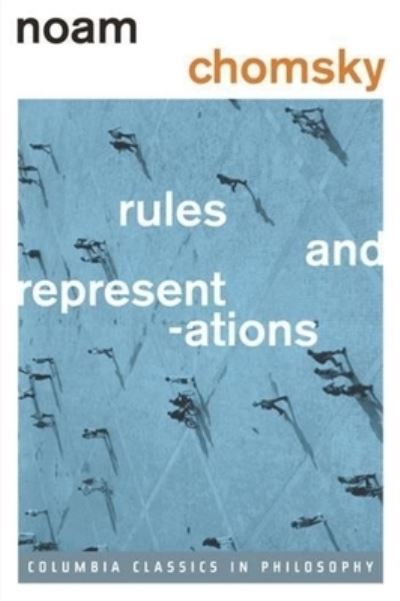
As Norbert Hornstein writes in his foreword, "it underestimates Chomsky's impact in linguistics, philosophy, and psychology to describe it as immense." In Rules and Representations, Noam Chomsky lays out many of the concepts that have made his approach to linguistics and human cognition so instrumental to our understanding of language.
In this influential and controversial work Chomsky draws on philosophy, biology, and the study of the mind to consider the nature of human cognitive capacities, particularly as they are expressed in language. He arrives at his well-known position that there is a universal grammar, genetically determined, structured in the human mind, and common to all human languages.
Aside from his examination of the various principles of the universal grammar-its "rules and representations"-Chomsky considers the biological basis of language capabilities and the possibility of studying mental structures and capacities in the manner of the natural sciences. Finally, he also explores whether there may be similar "grammars" of perception, art, human nature, scientific reasoning, and the unconscious.
Based on Chomsky's lively 1978 Woodbridge Lectures, this edition, first published in 1980, contains revised versions of the original lectures and two new essays. It also includes an extensive foreword by Norbert Hornstein, discussing Chomsky's ideas and their wide-ranging impact.
| ISBN: | 9780231132718 |
| Publication date: | 10th May 2005 |
| Author: | Noam Chomsky |
| Publisher: | Columbia University Press |
| Format: | Paperback |
| Pagination: | 368 pages |
| Series: | Columbia Classics in Philosophy |
| Genres: |
Linguistics |
He arrives at his well-known position that there is a universal grammar, genetically determined, structured in the human mind, and common to all human languages. Aside from his examination of the various principles of the universal grammar-its "rules and representations"-Chomsky considers the biological basis of language capabilities and the possibility of studying mental structures and capacities in the manner of the natural sciences.
Rules and Representations features in the following genres: Linguistics
Hardback, Paperback. Not Available.
Rules and Representations was written by Noam Chomsky and published by Columbia University Press
Rules and Representations has 368 pages
Yes it is part of Columbia Classics in Philosophy series