

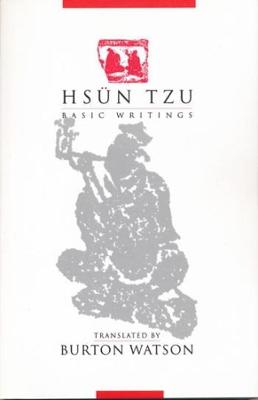
Hsun Tzu set forth the most complete well-ordered philosophical system of his day. Although basically Confucian, he differed with Mencius, his famous predecessor in the Confucian school, by asserting that the original nature of man is evil. To counteract this evil, he advocated self-improvement, the pursuit of learning, the avoidance of obsession, and constant attention to ritual in all areas of life.
With a translation by the noted scholar Burton Watson, includes an introduction to the philosopher in relation to Chinese history and thought. Readers familiar with Hsun Tzu's work will find that Watson's lucid translation breaths new life into this classic. For those not yet acquainted with Hsun Tzu, will reach a new generation who will find his ideas on government, language, and order and safety in society surprisingly close to the concerns of our own age.
| ISBN: | 9780231106894 |
| Publication date: | 18th September 1996 |
| Author: | Burton Watson |
| Publisher: | Columbia University Press |
| Format: | Paperback |
| Pagination: | 177 pages |
| Series: | Translations from the Asian Classics |
| Genres: |
East Asian and Indian philosophy |
Hsun Tzu set forth the most complete well-ordered philosophical system of his day. Although basically Confucian, he differed with Mencius, his famous predecessor in the Confucian school, by asserting that the original nature of man is evil.
Hsün Tzu features in the following genres: East Asian and Indian philosophy
Paperback. Not Available.
Hsün Tzu was written by Burton Watson and published by Columbia University Press
Hsün Tzu has 177 pages
Yes it is part of Translations from the Asian Classics series