

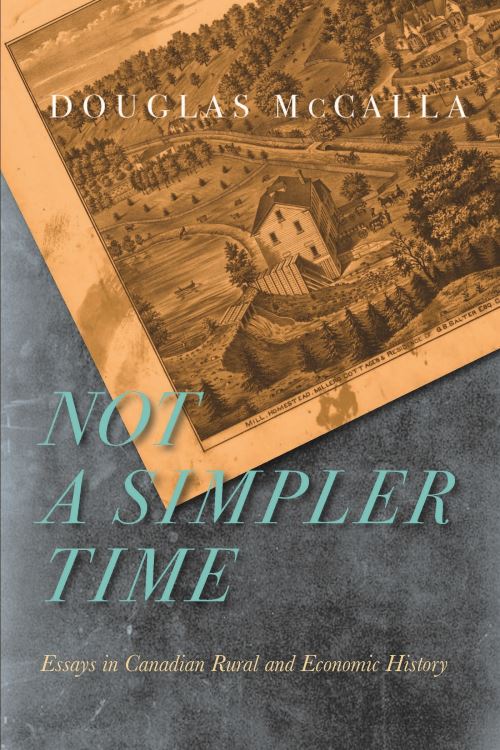
Although the great majority of Canadians lived in rural communities until the early 1900s, rural life has often been dismissed as marginal to the country's economic development. Not a Simpler Time challenges this view, arguing that the strategies, skills, and work of rural families were the backbone of the economy. In making this case, Douglas McCalla illustrates how established narratives can constrain new approaches to the past.
The book highlights the complexities of rural economies in early Canada, showing that the growth of the colonies that joined Confederation in 1867 relied far more on agriculture than on natural resources - a reality overlooked by proponents of the enduring staples thesis. Building on this argument, McCalla revises old stories: neither the timing nor the character of Ontario's economic growth stemmed from natural resources; the emergence of a new economic core in the colonies contradicts the perception that they were essentially an imperial periphery; and the First World War did not, in fact, transform the economy as often imagined.
That a focus on natural resources still dominates accounts of economic growth in Canada underscores the book's broader theme: recognizing the limits of older evidence and embracing new approaches will deepen historical understanding. Bringing together two decades of McCalla's scholarship, Not a Simpler Time will spark debate while offering an indispensable resource for Canadian historians.
| ISBN: | 9780228027843 |
| Publication date: | 23rd June 2026 |
| Author: | Douglas McCalla |
| Publisher: | McGill-Queen's University Press |
| Format: | Paperback |
| Pagination: | 300 pages |
| Series: | McGill-Queen's Rural, Wildland, and Resource Studies |
| Genres: |
History of the Americas Rural communities |
Although the great majority of Canadians lived in rural communities until the early 1900s, rural life has often been dismissed as marginal to the country's economic development. Not a Simpler Time challenges this view, arguing that the strategies, skills, and work of rural families were the backbone of the economy.
Not a Simpler Time features in the following genres: History of the Americas, Rural communities
Paperback. £27.90, down from the £31.00 cover price. Not Available.
Not a Simpler Time was written by Douglas McCalla and published by McGill-Queen's University Press
Not a Simpler Time has 300 pages
Yes it is part of McGill-Queen's Rural, Wildland, and Resource Studies series
£27.90, reduced from £31.00. Not Available.