

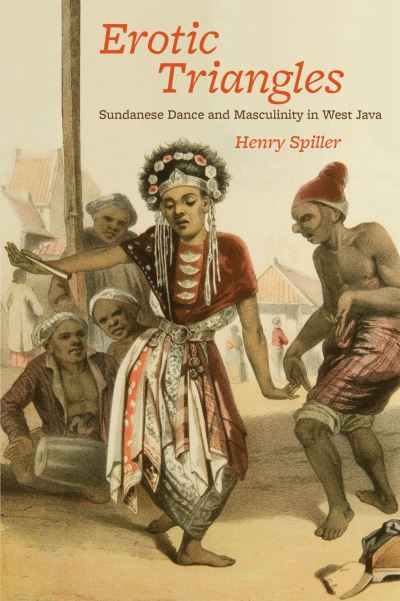
In West Java, Indonesia, all it takes is a woman's voice and a drum beat to make a man get up and dance. Every day, men there-be they students, pedicab drivers, civil servants, or businessmen-breach ordinary standards of decorum and succumb to the rhythm at village ceremonies, weddings, political rallies, and nightclubs. The music the men dance to varies from traditional gong ensembles to the contemporary pop known as dangdut, but they consistently dance with great enthusiasm. In Erotic Triangles, Henry Spiller draws on decades of ethnographic research to explore the reasons behind this phenomenon, arguing that Sundanese men use dance to explore and enact contradictions in their gender identities.
Framing the three crucial elements of Sundanese dance-the female entertainer, the drumming, and men's sense of freedom-as a triangle, Spiller connects them to a range of other theoretical perspectives, drawing on thinkers from Eve Kosofsky Sedgwick, Lévi-Strauss, and Freud to Euclid. By granting men permission to literally perform their masculinity, Spiller ultimately concludes, dance provides a crucial space for both reinforcing and resisting orthodox gender ideologies.
| ISBN: | 9780226769592 |
| Publication date: | 19th October 2010 |
| Author: | Henry Spiller |
| Publisher: | The University of Chicago Press an imprint of University of Chicago Press |
| Format: | Paperback |
| Pagination: | 288 pages |
| Series: | Chicago Studies in Ethnomusicology |
| Genres: |
Gender studies, gender groups Ethnic studies |
In West Java, Indonesia, all it takes is a woman's voice and a drum beat to make a man get up and dance. Every day, men there-be they students, pedicab drivers, civil servants, or businessmen-breach ordinary standards of decorum and succumb to the rhythm at village ceremonies, weddings, political rallies, and nightclubs.
Sundanese Dance and Masculinity in West Java features in the following genres: Gender studies, gender groups, Ethnic studies
Paperback. Not Available.
Sundanese Dance and Masculinity in West Java was written by Henry Spiller and published by The University of Chicago Press an imprint of University of Chicago Press
Sundanese Dance and Masculinity in West Java has 288 pages
Yes it is part of Chicago Studies in Ethnomusicology series