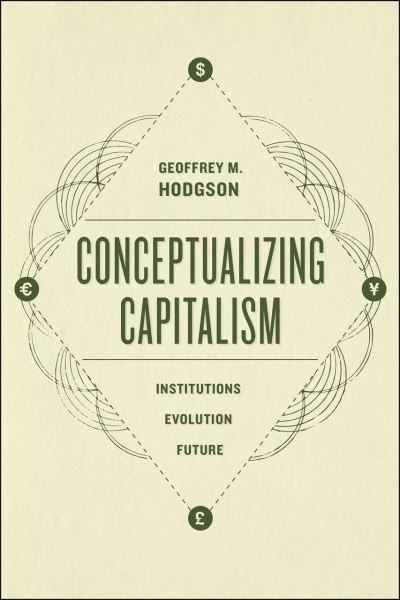
A few centuries ago, capitalism set in motion an explosion of economic productivity. Markets and private property had existed for millennia, but what other key institutions fostered capitalism's relatively recent emergence? Until now, the conceptual toolkit available to answer this question has been inadequate, and economists and other social scientists have been diverted from identifying these key institutions.
With Conceptualizing Capitalism, Geoffrey M. Hodgson offers readers a more precise conceptual framework. Drawing on a new theoretical approach called legal institutionalism, Hodgson establishes that the most important factor in the emergence of capitalism-but also among the most often overlooked-is the constitutive role of law and the state. While private property and markets are central to capitalism, they depend upon the development of an effective legal framework. Applying this legally grounded approach to the emergence of capitalism in eighteenth-century Europe, Hodgson identifies the key institutional developments that coincided with its rise. That analysis enables him to counter the widespread view that capitalism is a natural and inevitable outcome of human societies, showing instead that it is a relatively recent phenomenon, contingent upon a special form of state that protects private property and enforces contracts. After establishing the nature of capitalism, the book considers what this more precise conceptual framework can tell us about the possible future of capitalism in the twenty-first century, where some of the most important concerns are the effects of globalization, the continuing growth of inequality, and the challenges to America's hegemony by China and others.
Buy from our bookstore and 25% of the cover price will be given to a school of your choice to buy more books. *15% of eBooks.
Frequently asked questions
A few centuries ago, capitalism set in motion an explosion of economic productivity. Markets and private property had existed for millennia, but what other key institutions fostered capitalism's relatively recent emergence?
Conceptualizing Capitalism features in the following genres: Economic systems and structures
Paperback, Hardback. £18.00, down from the £20.00 cover price. Not Available.
Conceptualizing Capitalism was written by Geoffrey Martin Hodgson and published by The University of Chicago Press an imprint of University of Chicago Press
Conceptualizing Capitalism has 456 pages
£18.00, reduced from £20.00. Not Available.
Join Our Community
Join our community for the latest bookish news, reading recommendations, exclusive opening extracts, author events and competitions. It\'s all free. And enter a monthly draw to win a £50 Gift Card. See past winners here