

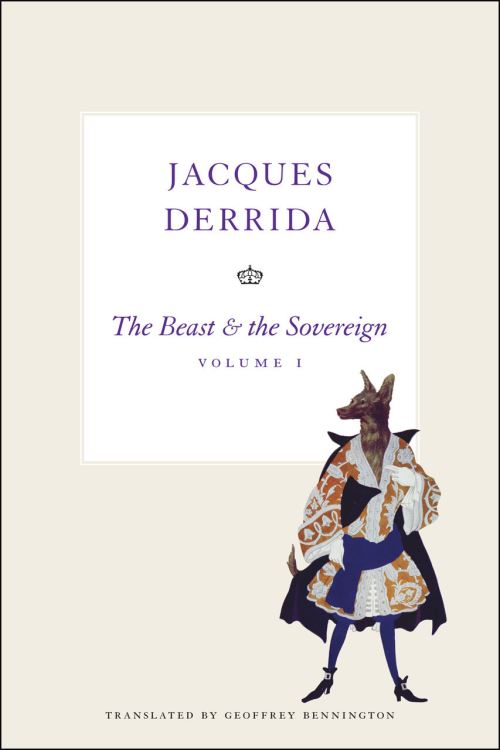
When he died in 2004, Jacques Derrida left behind a vast legacy of unpublished material, much of it in the form of written lectures. With The Beast and the Sovereign, Volume 1, the University of Chicago Press inaugurates an ambitious series, edited by Geoffrey Bennington and Peggy Kamuf, translating these important works into English.
The Beast and the Sovereign, Volume 1 launches the series with Derrida's exploration of the persistent association of bestiality or animality with sovereignty. In this seminar from 2001-2002, Derrida continues his deconstruction of the traditional determinations of the human. The beast and the sovereign are connected, he contends, because neither animals nor kings are subject to the law-the sovereign stands above it, while the beast falls outside the law from below.
He then traces this association through an astonishing array of texts, including La Fontaine's fable "The Wolf and the Lamb," Hobbes's biblical sea monster in Leviathan, D. H. Lawrence's poem "Snake," Machiavelli's Prince with its elaborate comparison of princes and foxes, a historical account of Louis XIV attending an elephant autopsy, and Rousseau's evocation of werewolves in The Social Contract.
Deleuze, Lacan, and Agamben also come into critical play as Derrida focuses in on questions of force, right, justice, and philosophical interpretations of the limits between man and animal.
| ISBN: | 9780226144290 |
| Publication date: | 9th December 2011 |
| Author: | Jacques Derrida |
| Publisher: | The University of Chicago Press an imprint of University of Chicago Press |
| Format: | Paperback |
| Pagination: | 463 pages |
| Series: | The Seminars of Jacques Derrida |
| Genres: |
Western philosophy from c 1800 |
When he died in 2004, Jacques Derrida left behind a vast legacy of unpublished material, much of it in the form of written lectures. With The Beast and the Sovereign, Volume 1, the University of Chicago Press inaugurates an ambitious series, edited by Geoffrey Bennington and Peggy Kamuf, translating these important works into English.The Beast and the Sovereign, Volume 1 launches the series with Derrida's exploration of the persistent association of bestiality or animality with sovereignty.
The Beast & The Sovereign. Volume 1 features in the following genres: Western philosophy from c 1800
Paperback. £26.10, down from the £29.00 cover price. Not Available.
The Beast & The Sovereign. Volume 1 was written by Jacques Derrida and published by The University of Chicago Press an imprint of University of Chicago Press
The Beast & The Sovereign. Volume 1 has 463 pages
Yes it is part of The Seminars of Jacques Derrida series
£26.10, reduced from £29.00. Not Available.